Blog

Geeking Science: Roads

Photo by Matt Duncan on Unsplash

Does anyone else Geek out about roads and road engineering? No? Just me then.

Well, I am going to completely Geek Out about the science of road engineering for a little bit.

Roads are FREAKING COOL!

These are one of the few places where you can see incremental improvements and how much a difference they make in our lives. For example, Rumble Strips invented in 1952 – they can be rolled into newly laid pavement or cut into existing pavement (Wikipedia – Rumble Strip) – are still undergoing improvement about where they need to be put and how. There is one on my postal delivery route down the enter of the lane, on a wide curve where it is easy to drift into oncoming traffic. I have been reminded of drifting at that location more than once; and considering the paint wear, so have others.

How about the raised pavement markers (patented in 1967) and the reflective paint used on roads? The visibility at night really helps. As does edge lanes, especially on two-lane rural roads. Can you imagine not knowing where the edge of the road is?  I remember when guessing the edge was a thing I had to do all the time … I love that white line of reflective paint to my right when driving down dark rural roads since its widespread addition with the turn of the century. And all the road lines – each contain a message – dashed is safe to pass, yellow means bad and white is good (Yellow on the left and white on the right means I’m traveling in the right direction, even if I can’t see any other signs). Brilliant. I’m talking about the raised pavement markers reflecting on highways on dark stormy nights. Age makes even the reflective paint lines hard to see; those plastic markers even work with astigmatism.

Does anyone else think about stormwater and roads and admire all the ways road engineering works to move the water off the impermeable surface to prevent road flooding and hydroplaning? When I started driving back in the early eighties, hydroplaning was common, but between road improvements, tire improvements, and car improvements (especially with the anti-lock brakes being added as a common safety device in the late eighties), I rarely feel loss of control.

Going into curves where the road is tilted, so you don’t have to slow down and you retain control easily is awesome. For a time, I lived on a road where the road was not tilted right. Both ways needed a sign saying “SLOW – 25 mph”; that was a true maximum speed. Drivers who didn’t heed that slow down from the 35 mph before and after the curve, ended up in my yard all the time. Having the engineers tip highways correctly makes me happy.

The slight bow in the road also is cool beans to have the stormwater divert off the road to either side, into the drains which run it to the nearest stream.

Related to water is the berms and center areas and their vegetation. Berms built up on the side of the roads decrease sound pollution when the soil and plants absorb the extra sound waves. The center areas and berms on highways not only mitigate traffic accidents, and control flooding with by providing ground with permeable surfaces, they reduce eyestrain – green and plants being kinder on the eyes than black asphalt and white concrete. The soil areas also, thanks to recent innovations of adding wildflower meadows, provide opportunities to create biodiversity for the planet. In urban settings, trees planted along roads reduce the sun hitting the streets, reducing the road heat sink as well as capturing rain water and decreasing street flooding.

Green reduces stress – scenic parkways increase relaxation. (Green Cities) My city has a parkway – green median, treelined, great berms – which runs through town about a mile south the “main street” with all the shops, malls, and doubles as a highway. Whenever I have the option of the parkway, I grab it even if the travel distance is longer. Strangely, because of the stop and go lights on the main street, the timing ends up being the same no matter which one I take.

More recent engineering designs for roads include:

  1. Safety edges – instead of a dropoff of pavement at the side of the road, installing a bevel making it easier to pull off the road if there is no shoulder and to get back on the road surface.
  2. Pedestrian Islands – when crossing multiple lanes of traffic, put an island in the median for the walkers to stop paying attention of traffic traveling one way, and start paying attention to traffic coming the other way.
  3. Reflective Backplates – instead of traffic signals being lights hanging against the dark, being lost in the tall building lights of an urban environment, yellow squares offset the lights from the back behind them, increasing visibility. (7 Roadway)
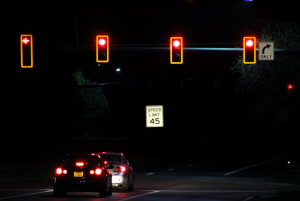
Image Source: https://www.pwmag.com/roadways/video-lighthawk-alpolic-350-traffic-signal-back-plate-from-korman-signs_o

All these inventions and innovations for Roads. The constant improvement. Isn’t it freaking Geeking cool?

In case you ever wonder what I think about as I drive to writing conventions.

Do you have any favorite road engineering features? Comment below.

Bibliography

“7 Roadway Engineering Design Strategies to Make Road Safer for Drivers.” Traffic Safety Store. 18 September 2018. (https://www.trafficsafetystore.com/blog/7-roadway-engineering-design-strategies-to-make-roads-safer-for-drivers/ – last viewed 11/10/2023)

Cole, Steve. “The History (Invention) of Road and Pavement Striping.” Performed Thermoplastic. 15 August 2022. (https://preformedthermoplastic.com/the-history-invention-of-road-and-pavement-striping/ – last viewed 11/10/2023)

“Green Cities: Good Health.” University of Washington. (https://depts.washington.edu/hhwb/Thm_SafeStreets.html – last viewed 11/10/2023)

Greenfield, Patrick. “Wildflower meadows to line England’s new roads in boost for biodiversity.” The Guardian. 1 December 2020. (https://www.theguardian.com/environment/2020/dec/01/wildflower-meadows-to-line-all-major-new-uk-roads-in-boost-for-biodiversity-aoe – last viewed 11/10/2023)

“The History of Anti-Lock Brakes.” Did you know cars. (https://didyouknowcars.com/history-of-anti-lock-brakes/ – last viewed 11/10/2023)

Owen, Erika. “Why the Lines on Our Roads Look the Way They Do.” Travel + Leisure. 2 August 2016. (https://www.travelandleisure.com/trip-ideas/road-trips/history-of-lines-on-roads – last viewed 11/10/2023)

Wikipedia. “Raised Pavement Marker.” (https://en.wikipedia.org/wiki/Raised_pavement_marker – last viewed 11/10/2023)

Wikipedia. “Rumble Strip.” (https://en.wikipedia.org/wiki/Rumble_strip – last viewed 11/10/2023)

Book Review (SERIES): Piled Higher and Deeper

I followed this webcomic for a while and when there was a kickstarter, I jumped on it, getting all six of the comic collections in one swoop in August 2018. Well, life was crazy, then it got more crazy, then still more and so I never got around to reading this particular books even though they were on my bookstand TBR immediately pile at least four years. Well, the time came to read them since I needed a Male Series Book Review. A delightful task! Plus a bonus in nibbling away at my personal goal of reading more BIPoC authors with twenty-four books to be read in 2024.

If you are academia or writing or science, you might really appreciate these humorous stories and comics. They are dated, especially the early ones, over twenty years have passed since the “cutting” edge of graduate school was first drawn, but they also bring memories back of important events and old technologies.

Created by Dr. Jorge Cham

Chapter 1: Piled Higher and Deeper: A Graduate Comic Strip Collection
Chapter 2: Life is Tough and Then You Graduate
Chapter 3: Scooped!
Chapter 4: Academic Stimulus Package
Chapter 5: Adventures in Thesisland
Chapter 6: 20th Anniversary

Amazon Cover

BOOK BLURB ON AMAZON for PILED HIGHER AND DEEPER

A collection of the first five years of “Piled Higher and Deeper,” the unique and popular comic strip about life (or the lack thereof) in graduate school, as it originally appeared in Stanford University’s “The Stanford Daily Newspaper” and online at www.phdcomics.com “Piled Higher and Deeper” the comic strip is currently published in several newspapers and online, where it is read by grad students from over 1000 universities and colleges in the US and from around the world.

MY REVIEW for PILED HIGHER AND DEEPER

Oh, how many years have I been enjoying this comic? A very long time. This collection is from the early years where the characters are being developed. I enjoy the later years more, especially as Cecelia gets deeper in her thesis writing, but the first book establishes the tone well.

I haven’t really read the story in about a decade – so after COVID and the increasing taking advantage of workers desperate to learn and the debilitating student debt, some of these jokes are hitting different. Humor changes. Not good or bad, but different.

This particular set of jokes were originally written between 1997 and 2002. Therefore 22 to 27 years ago.


Amazon Cover

BOOK BLURB ON AMAZON for LIFE IS TOUGH AND THEN YOU GRADUATE

This book is the second collection of the popular comic strip Piled Higher and Deeper, which chronicles life (or the lack thereof) in grad school. Includes the popular strip series “Procrastin-X”, “Grad school makes you dumber”, “The Thesis Zone” and Mike Slackenerny’s improbable thesis defense. Bonus features include never-before published strips, author notes and a foreword by Karl Marx. Whether you managed to escape grad school, are struggling through it, or are thinking of applying to it, Piled Higher and Deeper will have you lauging and crying at the same time. Piled Higher and Deeper is published online at www.phdcomics.com, where it receives over 1.8 million page views a month from grad students all over the world.

MY REVIEW for LIFE IS TOUGH AND THEN YOU GRADUATE

For Piled Higher and Deeper comic, Chapter 2 covers year Six (2002-2003) to year Eight (2004-2005).
The cast of our intrepid graduate students continue in their quest for the golden diploma. Cecilia both fears she will never reach it and is terrified of passing the goal. The unnamed main character juggles both a career and research … poorly. Tajel continues her political fire while working on figuring out what her thesis could be. Dee starts grad school. And Mike Slackenerny … he has a baby on the way and a defense to present. Free food will not fill the void between the two forever. After decades, pressure is growing for him to produce something.

PhD continues with the highly diverse cast, with a mix of Americans and imports as often happens in PhD programs, especially in California.

I’m reading the story in 2024, written with 2005 technology … students still procrastinate with email instead of social media. With desktop computers with a single screen, just a few palmpilots to record information. It’s interesting how much the tech has changed over the years but the people haven’t.

If you like the series, you will like the paperback format.


Amazon Cover

BOOK BLURB ON AMAZON for SCOOPED!

The third collection of the popular comic strip Piled Higher and Deeper, which chronicles life (or the lack thereof) in grad school. Includes the popular strip series “How to write your Thesis title”, “The Scientific Method vs. The Actual Method”, “Valentine Gift Ideas for your Advisor” and many more. Whether you managed to escape Grad School, are struggling through it, or are thinking of applying to it, Piled Higher and Deeper will have you lauging and crying at the same time.

MY REVIEW for SCOOPED!

Chapter 3 of PhD covers years 2005-2007, with the back matter reporting on Dr. Cham’s college tour of 60 campuses (pp. 133-154). The college tour section is interesting to see the author’s illustrations change over time in a manner similar to chapter 1 as he learns a new format and story telling technique.

This is a story of the long journey to the special diploma via making a huge (or minuscule but at least unique, mostly, unless you are scooped and then pivoting on the fly unless you discover they didn’t really do your work, probably) addition to humanity’s knowledge and, for some of our intrepid graduate students, endings. Cecilia’s love of her life ends up being a toss up between her quest for technology and another human being. Mike Slackenerny pressure from wife and child and funding and professor needing to show progress finally culminates in words on screen and paper.

The author continues to grow in storytelling skills and the skits gets longer and more complicated. He has to trade off the consistency of the world-building environment with pushing forward to create new jokes and plotline advancement to maintain interest, which he does well.

Overall, another good steady release for the PhD comics.


Amazon Cover

BOOK BLURB ON AMAZON for ACADEMIC STIMULUS PACKAGE

The fourth collection of the popular comic strip Piled Higher and Deeper, which chronicles life (or the lack thereof) in academia. Includes the popular strip series Quantum Gradnamics, ANOVA: Analysis of Value, Seminar Bingo and many more. Whether you managed to escape academia, are struggling through it, or are thinking of applying to it, this smart comic strip will have you laughing all the way.

MY REVIEW for ACADEMIC STIMULUS PACKAGE

Another solid addition to the PhD comic collection with Chapter 4: Academic Stimulus Package. This particular volume covers the strips from 2007-2009 – I’m reading and reviewing it in 2024.

I think overall this is the best so far, but it could just be the introduction of so many graphs. As any graduate student will tell you, adding graphs to prose can get you all sorts of upticks with your advisors. Graphs are seductive.

Technology continues to advance and the characters are finally hitting the commonplace stuff we use today (2024). Facebook makes its first appearance as a time waster for our unnamed protagonist’s procrastination. He also adds a second monitor and is thinking about a third. Plus the new monitor is a flatscreen rather than the cathode ray tubes monitor us readers have seen taking up huge amounts of space on the desks of our favorite graduate students.

The back matter, like last time, includes information about Dr. Cham’s book tours. The big difference this time is including comic-strip overviews of dissertations and experiments people shared with him during his travels including working with colliders in search of the Higgs-Boson (confirmed in 2012/2013 at CERN, the very place Dr. Cham visited in 2008), how research time works at telescopes, and using cancer cells to measure uranium leakage into ground water. — This fascinating information providing a jumping off point for Jorge Cham’s later interest of creating scientific fact sharing books like “We have No Idea” in 2017 on top of the PhD comics.

Watching authors evolve in interest and ability always fascinates me.

Best of all – the biggest advancement in the technology – is COLOR!!!!


Amazon Cover

BOOK BLURB ON AMAZON for ADVENTURES IN THESISLAND

Life in Academia never seemed livelier than in this humorous take on grant writing, academic dress codes and the many uses for lab coats. Follow the phenomenon known as PHD Comics in this fifth book collection of the popular online comic strip. What would happen if Newton tweeted? If TV ‘Science’ shows were more like real science? If research papers had a comment section? Also included are excerpts from the script of the recently released ‘The PHD Movie’ and author Jorge Cham’s comics journal of his travels and his detention by the U.K. border police.

MY REVIEW for ADVENTURES IN THESISLAND

Collection Five of PhD comics: Adventures in Thesisland continues the wonderful color and presents the years 2009 to 2012. The tech and social media have caught up with modern standards completely, adding Tweets to the procrastination mess. I found this collection the most relatable of the series.

Highlights:
1. PhD made a movie! (Go them!)
2. p. 27 – Why is this still my desktop? I finished my graduate studies fifteen years ago. And when did Dr. Cham visit my house?
3. Thesisland series – Alice in Wonderland side-trip is some of the best art done in the entire series.
4. p. 82 – Can I bottle the statistics on this and send it to all media centers?
5. p. 219-222 – Another of Dr. Cham’s travel log reports. This one is … scary? disappointing? frustrating? prophecy? A report of him being detained in 2009 and nearly not able to make his lecture schedule. When he shared what happened, readers around the UK and the US shared how many non-white academics are being “returned to sender”. Are tensions worsening because of the bigotry or is bigotry worsening because of the actions to avoid tension? “Still, I keep looking over my shoulder for some reason.” – most of what Dr. Cham writes is real life for amusement sake, but sometimes it is just real life.

As always, the series is funny for those who spent too much time in academia. Or in the hallowed and hollow halls of science. Highly recommend.


Amazon Cover

BOOK BLURB ON AMAZON for 20th ANNIVERSARY

Celebrate 20 years of PHD Comics with us! This sixth collection of comics continues the saga of Cecilia, Mike Slackenerny, Tajel and the Nameless Hero as they deal with tough advisors, frustrating undergrads and writing their thesis. This collection contains exclusive essays by Jorge Cham on why he started drawing the comics, who inspired the characters (including Prof. Smith!), and where all his ideas come from. Other highlights include PHD Comics’ take on Dr. Who, Les Miserables, and Downton Abbey. Want to know how many academics it takes to get a Powerpoint presentation to work? Or where you stand in the lab/department hierarchy? This book has comics for you. It also includes Jorge’s Tales from the Road comics and a handy guide to Academic Regalia.

MY REVIEW for 20th ANNIVERSARY

Unlike most 20th Anniversary Collections, this is not a cherry-pick of the last twenty years of the PhD comic strip, instead it is really Collection Six covering years 2012 to 2014. Note that while this is the last of the printed collections, Dr. Cham continued to make more strips and publish them at his website until 2021. Well, he really stopped sometime in 2019. No new strips were published in 2020 and only six more published in 2021.

In this collection he talks about the births of his son and daughter and how they impacted his strip in his author’s notes -so if the last baby was born in 2014, then 2019 would be having a seven and five year old (guessing) and 2024 (when I am reading this) would be a 10 and 12 year old children – maybe older. He switched to longer form stories, looks like the most recent one is “Oliver’s Great Big Universe”, and his FaceBook page is still active (unlike his webpage which doesn’t even include the 20th anniversary book). He gave us a career, over 20 years, of comics and academia humor; I guess he is allowed to start his second career (or is it third? – did his grad studies count as one?). We have really enjoyed the ride he provided with the comic strip portion of his life.

I loved this particular collection for Cecilia really cracking down on getting her thesis written. As someone in the publication industry, her struggles of getting words on screen is very real. p. 153 – “Ok, I need to transfer my thoughts from my head to this screen. C’mon, Write! — (she brings her head into contact with the computer screen) They’re Touching! Transmit! Transmit!” — I feel this to the depths of my soul every time.

Great collection. Sad to come to the end of this series readthrough. But it is a great collection, and a great collection of collections.

Flash: Negative One is a Value

ID 177155887 | Vodka Bottle © Maryia Kazlouskaya | Dreamstime.com

Jacc grabbed for the bottle, but despite having more of the vodka in him than the bottle, Jeff easily dodged his sibling. “Come on little bro, give it over. You have had enough.”

“Who says enough? I ain’t no quitter.” Jeff’s snarky smile turned Jacc’s stomach.

Shaking their head, they said, “It’s destroying you.”

“My body, my choice.” The broken chair he fell in crackled under his light weight. While liquor had a lot of calories, when you don’t eat anything else, you lose pounds.

“It’s destroying everyone around you.”

He snorted before opening the screw lid and downing another chug. Pointing a finger with the hand holding a bottle at the only person still willing to come by his place to make sure he was still alive. “Better a negative than a zero.”

“What?”

“Oh, you remember, everyone while we were growing up said I would never amount to anything. A big fat zero.” His smirk deepened. “At least as a detriment, I am not zero. I am negative all the way, baby!”

(words 174, first published 9/15/2024; written 8/27/2024)

Editing Rant: Bloody Times

Photo by Alexandre Boucey on Unsplash

Okay guys, do NOT look away. I’m writing this editing rant because a male author got this HORRIBLY wrong.

Menstruation.

Women go through this all the time. And everyone in society should KNOW about how it impacts the people living through it – and by everyone, I mean male and female and whatever other genders there are – they need to know for their mothers and daughters and wives and coworkers and friends and kin and kith and strangers.

For the particular science fiction driving this editing rant, the world had been so far advanced people could use nanites to make themselves dragons, and teleport, and do everything. Then their science had a critical failure and everything started over. They had to learn to become farmers again instead of the machines doing everything. They had to learn to fight over scarce resources. They had to recreate governments.

And they had to learn to deal with bodies no longer under their total control. The women started menstruating, and the author devoted time in the training montage of adjusting to the new society to discussing how the society adjusted to this fact of life and biology.

I would be tickled about him including this important aspect of life … except …

He did it poorly.

The portion of the review applicable to today’s rant:

My biggest problem with the sexism in the book is when the menstrual cycles restart in women. (The science-fiction author) does do a good job of having the true-to-life wide-range of physical impacts, from just a few cramps to being curled in a ball for days. But the initial dissemination of information about it was totally unbelievable. I do not see women who have forgotten this problem ever existed immediately referring to it as “the curse.” Nor do I see immediately separating men from women to share the information and all the women saying “you don’t want to know”. And when the men finally figure out the “secret”, anytime the subject comes up thereafter cringing and walking away. I see the first reaction of sharing the information openly so a society in recovery knows that half their working population may be taken offline for a few days every month and how the problem can be dealt with. I also see the men curious because no one taught them it is a grody thing. Instead, everyone in the story treats it as unnatural, even while immediately looking at breeding animals and planting farms. I was thrown out of the story because it was not in-line with previously established social aspects. In a society of gods where everyone modified their body regularly, sometimes daily, not discussing a change of body only a couple months later is unreal. 

I absolutely hated the disconnect between the world the author had built and the revert our present society’s TOXIC reaction to a bodily function.  So not only was it sexist, it made all the careful crafting which had gone before irrelevant. Learn about menstruation folks and how to present it.

For something that takes up about seven YEARS of a woman’s life, just shy of 10% of her lifespan, literature leaves it a huge hole. The topic does get addressed during some Young Adult stories, when a female is coming of age, but that is pretty much it. On rare occasions, a woman in a romance might make a decision based on her cycle – usually what clothes to wear. Other than that, the lack of period is brought up more than having a period. Between teens and fifties, women spend three-to-seven days of 21-to-35 days dealing with a messy discharge – say on average 20% of their time during the “prime” of their life. Often with side effects including, but not limited to, cramping, nausea, migraines, and bloating.

If you include menstruation, for whatever reason, remember to do it right. At least half your audience KNOWS the topic well.

And for the love of goodness, stop the stigma – it isn’t a “curse”, nor a “secret visitor”, and don’t tell men “you don’t want to know”.