Book Review (SERIES): Tales from the Long Night

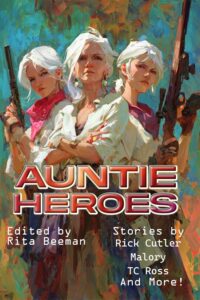
Tales from the Long Night is a new universe by J. Kenton Pierce. Each story, so far, has been a stand-alone, but some will slowly work their way into full series. I had fallen into this Universe through a short story “Big Mama” in an anthology Pogue One; I told you about the Anthology as my March Book Review (3/3/2026). I wanted so much to see more of this universe so I went searching, and now I have two novellas and one novel under my belt. I don’t know if there are more short stories from this universe in the Raconteur Press Anthologies; if so, I hope someone will collect any short stories under one umbrella, but any collection will need to wait at least a year from the Anthologies publications because of contracts.

The stories I have read so far in time order of the Long Night Universe (because, yeah, it is that sort of universe – again, these can be read in any order. So far the author has been really good at compartmentalization):

  1. Big Mama (short story in Pogue One) – published January 9, 2025
  2. An Apple for the Legion (novella) – published April 20, 2026
  3. Back Alley Angels and Badland Devils (two novelettes) – published November 18, 2025
  4. A Kiss from Damocles (novel: Book 1 of Shai) – published June 26, 2005

The order I actually read these were Big Mama, Back Alley, A Kiss, and An Apple.


Amazon Cover

BOOK BLURB ON AMAZON FOR An Apple for the Legion

From the universe of the 2026 Prometheus Award finalist A Kiss for Damocles — welcome to the Tales from the Long Night.

Third Decanus Kaur was engineered for this.

The Mutual Prosperity builds its legionaries from the genes of heroes — and Kaur carries the literal face of Tanveer Kaur, hero of the Spring Thunder Campaign, the soldier whose sacrifice helped pull humanity back from extinction. She has trained since birth to liberate the enslaved populations of the Terran Commonwealth. She has memorized the Social Virtues. She has crushed her doubts, disciplined her questions, and proven herself a worthy daughter of humanity’s finest.

Then she lands on Hesperides Colony, and the liberation refuses to go as planned.

The colonists fight like they mean it — not from ideology or fanaticism, but because they have something worth protecting. When her commander hands her a contraband biography of her own mother and tells her to read it, the headaches begin. Because what Tanveer Kaur actually believed, actually said, in her own unedited words — it doesn’t match anything the Prosperity taught her daughter.

Then the volcano erupts.

Cut off from Fleet. No resupply. No evacuation. A dying colony buried under ash, a population the Prosperity considers expendable, and orders that grow more monstrous by the hour. Kaur is twenty-three years old. She commands ten legionaries. And the man who has spent decades teaching her what it truly means to honor her heritage is running out of time to finish the lesson.

An Apple for the Legion is a gripping, character-driven military science fiction novella — precise, dark, and impossible to set aside. A story set in the Tales from the Long Night: a universe where humanity survived the stars and built something that might not have been worth saving.

MY REVIEW FOR An Apple for the Legion

Is ignorance tolerable as a form of innocence?
If so, never enter a library, and never, ever be ground troops freeing a people. In both cases you might be pelted with books and knowledge.

Kaur is a genetic descent of a great war hero, redesigned and improved, optimized for strength…and intelligence and leadership, which may have not been the best move by a totalitarian government to create an obedient solider even with restricted information access, nighttime reprogramming, constant retraining, and obsessive observation. Curiosity, valuing the soldiers she is in charge of, and the ability infer from limited data sets makes her a piss-poor “follow orders” leader no matter how deep the programming is.

Kaur likes apples. The fruit of the knowledge of good and evil. And since falling from the heavens to the hell on earth that is the Hesperides Colony after the invasion Kaur is part of, the Eden of her mind keeps getting hit with seismic blows.

Caught between Muse and Mentor, Kaur has to decide how much of the Apple she will accept.

Tales from the Long Night is a strong world J. Kenton Pierce has created. Each part can be read as a stand-alone; An Apple for the Legion, especially, works well as it is a prequel to the two main series of the universe. The science fiction novella is set in the beginning of the apocalypse Hesperides experiences. Most of the rest of the stories are set in the aftermath.

This story, for fans of the series, is a must-read as it gives a hint at what else is happening in the universe. I hope that Mr. Pierce collects the short stories he has also written for this universe into one collection to fill things in even more.


Amazon Cover

BOOK BLURB ON AMAZON FOR Back Alley Angels and Badland Devils

In a galaxy ravaged by fallen empires, endless wars, and a volcanic apocalypse, hope isn’t bestowed by fate—it’s forged by gritty survivors reclaiming their freedom and heritage. Welcome back to J. Kenton Pierce’s epic Tales from the Long Night universe, where ordinary heroes rise against the encroaching dark.

Back Alley Angels and Badland Devils delivers two pulse-pounding stories spotlighting the unsung warriors of Hesperides Colony, scarred by the Mutual Prosperity’s invasion. These raw tales of resilience pit flawed protagonists against hostile xenos, ancient horrors, and shadowy schemes.In “The Greenline Gambit,” set centuries into the Long Night, amiable brawler Kraitte thrives in the subterranean sprawl of Greenline Town—a former refugee sanctuary turned industrial hub. By day, he’s a heavy lifter; by night, a smuggler’s guardian. But when a mysterious brunette offers a high-stakes job, Kraitte plunges into a web of rival factions vying for underground power, testing his newfound sense of home and family.

“El Banquero del Diablo” rewinds to the invasion’s chaotic aftermath, amid ash-choked volcanic winter. Rugged cowboy Danny Bozeman, a former rider for Boss Rosenberry, joins the nascent Nuevo Tejas Rangers to rebuild society. Preferring simple brawls and bar tabs, Danny confronts capital-E Evil—an ancient darkness threatening innocents—armed only with unyielding grit and iron resolve.These standalone adventures weave into the saga’s larger arcs, proving heroes emerge from back alleys and badlands, not thrones. In a cosmos of implacable threats, the fight for dawn is eternal. Join Kraitte and Danny’s ruckus–and learn what it means to never quit.

MY REVIEW FOR Back Alley Angels and Badland Devils

Back Alley Angels and Badland Devils is a dual short-story collection totaling 100 pages in paperback. Both stories are good, though I preferred the second, “El Banquero del Diablo.”

Both stories are set in the post-apocalyptic science-fiction “Tales from the Long Night” universe created by J. Kenton Pierce, and have a large male protagonist doing the business of right but in a wrong manner. These are not white-hat heroes; they wear gray proudly. This universe, if you are not familiar with it, has a distinctly weird-west sci-fi feel similar to steampunk but in its own category with Star Wars, Westworld, Company A: The Origin of the Martian Rangers by Peter Prellwitz, and A Fistful of Dust by A.G. Carpenter. I should note that the second short story crosses from weird-west sci-fi into horror.

The Greenline Gambit is set in the same time as A Kiss from Damocles, the first full-length novel set in the TFTLN Universe. Kraitte, married to a cop but making his living in the underbelly of the Greenline as a day-laborer and a night-opportunist, finds himself at cross-purposes with the law. They want his skills and he doesn’t want to be noticed, especially with the genetic baggage he carries. But two new players are messing with the balance between legal and not-so-legal, and it makes the cops nervous. The cops, criminals, and new factions all are playing with him like he is a disposable piece in their power games. Can he flip the board without losing the game?

El Banquero del Diablo stars Danny and Jenny, two Rangers on a newly compromised world (set about 500 years before the Greenline Gambit). These first generation of Rangers from Hesperides Colony create the legends, the boots, later generations try to fill with honor and inspiration. These early Rangers, though, are unlike the expectations of later legends. They, well, were city rats and problem-makers sentenced to be front-line soldiers or spend life in prison. They are dirty, crafty, and dangerous. The only reasons judges sentence them to miliary service is jails wouldn’t hold them long.

These potential monsters, having accepted the leash of civilization then getting slammed on a planet facing volcanic winter, now inflict civilization on monsters who won’t accept the leash. Slavers, killers, and enemies from the stars. The El Banquero short story follows them chasing one such monsters to ground and cornering him against the sea with his posse. Closing on him, Danny and Jenny discover that monsters come in all shapes and sizes and varying degrees of nasty.

Like I said, El Banquero is my favorite of the two stories. Great characters, FUN dialog, and real stakes. Greenline is an “only” investigation; Banquero is a gun-slinging adventure. Both are really good.


Amazon Cover

BOOK BLURB ON AMAZON FOR A Kiss from Damocles (Book 1 of Shai)

The enemy is dead. Their guns still aim.

The Mutual Prosperity invaded Hesperides Colony centuries ago–dropped asteroids on the oceans, triggered a volcanic winter, killed millions. The invaders eventually died fighting. Their orbital artillery AI, Damocles, did not. It has spent three hundred years killing anything that looks like a threat: radio signals, powered vehicles, anything that might let humanity rebuild fast enough to strike back.

Seventeen-year-old Shaifennen “Shai” Roehe grew up in a mineshaft, scrounging salvage from the ruins of a dead civilization. Then she finds a crashed military shuttle from the Long Night buried in a highland ravine. It’s the biggest salvage find in living memory–and it comes with secrets. Traitors from the original war. A murdered alien marine who died fighting for humanity’s future. And enough battlesteel and fabrication equipment to turn her struggling homestead into something that scares the right people.

From there, Shai has to navigate a volatile trade mission to the nearest town, untangle a conspiracy that runs generations deep, survive assassination attempts, and figure out why every faction on Hesperides–the Riders, the Archive, the alien Imps, the new Trade Association that smells a lot like the old tyranny with better hair–seems to already know about a project she has only just stumbled into.

Shai’s universe is one filled with fallen empires, implacable war machines, lost civilizations, hostile xenos, the occasional ancient unspeakable horror, and she’s going to bring the ruckus to every corner of it.

Winner the 2026 Prometheus Award for Best Novel, A Kiss for Damocles is the first book in the Tales From the Long Night series. Post-apocalyptic science fiction with a ferocious protagonist, deep world-building, earned political stakes, and a genuine belief that humanity can take back what it lost — if it can stop fighting itself long enough to try.

MY REVIEW FOR A Kiss from Damocles (Book 1 of Shai)

I read one of the short stories Mr. Pierce has created for the Tales from the Long Night and knew I had to have more and I went looking and discovered this novel.

The wonderful cross of western and science-fiction comes across in the language and circumstances on this post-apocalyptic world where an orbital bombardment had set off the planet’s equivalent of the Yellow Stone Caldera. This story is set when the survivors of the colony caught in the crossfires between two interstellar empires finally are beginning to crawl out of their Volcanic Winter and face the “landmines” left behind by the war, specifically a space platform set to destroy anything that looks like higher man-made technology.

It’s hard to advance when any advancement leads to precision orbital bombardment by an ancient long-forgotten-by-its-creators platform.

A young female scrounger finds the score of a lifetime, not only for her but her community. The waves of which will either be felt around the world, or stolen from them. A Kiss follows Roehe from find, to family, to foe. Can she keep her head and her temper long enough to gain the benefit without calling down disaster upon everything.

I just love the western flavor, the scrapy characters, and the defiance against a world that was never the cradle of humanity.

Editing Rant: Filtered

Photo by Grace Ho on Unsplash

I don’t have the bandwidth today to do a deep dive into this. I had been thinking about saving Filtering for a writing exercise, but I’m just done at the moment. No brain left, so here goes words to rip out of the manuscript.

First draft (or zero draft, however you count), you will write a lot of “he saw”, “I felt”, “she heard,” letting a reader know what the point of view (POV) character witnessed. You might even see a lot of this in my fiction writing here on the blog, since I post mostly flashes – which means first draft stuff.

Anyway, during the second draft these need to come out.

Don’t put a barrier between the reader and what is happening.

“I heard the engine coming down the track, the long whistle blowing.”

Well, the reader knows if something is happening, the POV is witnessing it, less needs to be said about the process of witnessing.

“Clicky-clack, the engine is coming down the track. The long whistle blowing it’s mournful cry.”

With which sentence do you hear the engine and whistle more clearly?

Get rid of the filter words.

And don’t just take my word for it – here is a vlog from Alyssa Matesic (Cut these words now) – start at 1:10:

****

Okay, had a night’s sleep, now back to this editing rant. I’ve said a LOT about filtering words here on this blog over the years. Editing rants based on book reviews, slush reads, and so, so many edits, but part of this one was directed at me. Yes, all the editing and I still need to yell at myself about filtering words.

Recently, I wrote a four thousand plus word Flash to fill in a 2000-word flash hole in my 2024 line up called “Water Finds a Way” (9/29/2024). (I’ve been doing really good this year in cleaning up my backlog.)

The story was based on a dream I had that previous night. Very vivid – the water over the tiled pool room with a keystone design, the crawling up and down the missing stairs, seeing the approaching pirates through the magic window, the light house, the betrayal, the lightning flashing in the pool after I threw the clerical charm in there and seeing the silhouette of the monster in the waters. The challenge was to make that dream a reality on paper.

Problems with the story – time to developmentally edit myself:

(One) I chose to do it as first-person because that was how I dreamed it. Sometimes I dream in third person, but most of them are first person. Only the additions I did to make it into a full story instead of an action sequence from the middle of the story (there wasn’t a beginning or end, nothing to set it up and nothing to tie it up, I had been dropped into the story in media res), the backstory for the person operating the lighthouse, made them a less than interesting point-of-view from inside their head. They didn’t know where they had come from, nor did they have strong goals. And they didn’t have anyone to talk to so all the thinking was internal. Boring.

I need a different POV choice for the story. I think third person, where the lighthouse keeper talks to themselves could work, especially if I have one or two of the pirate crew be a second POV. Maybe the apprentice cleric; it would be interesting to compare two people caught up in situations where they are not allowed to leave. Situations which offer safety but at the cost of agency.

(Two) I just pounded out that 4,300 word story over a six-hour day with just one meal break. The ending got cut short by the need to sleep. Everything got tied up quickly, where the impact of the rope goal was just set up. The final two paragraphs would be better as two more pages.

(Three) With the quick write-up without a break, so many filter words were used. What I saw in the story needed to be written out – saw, felt, heard, believed, thought. The whole things need a rewrite to remove the filter words. I need to change description into immersion. Rip the barriers away!

(Four) The magic window, which was WAY COOL in the dream, does not work in the created story. It is a Darling and needs to be killed. Unless I can find a way to keep it. (My precious!)

(Five) I would like this to be a saleable length, so 10k. I had rushed things just to finish the blog in one day and fill a slot, but it is over 4k words already. That is some serious wordage. With a rewrite filling in the rushed descriptions, even with removing filter words, it should easily hit 6k and adding the second POV (Cleo) and a scene or two setting up stuff before the pirates arrived at the lighthouse – let’s see, them on boat where the pirate asks for payment as they race the storm to the mainland and another with them walking up from the pier (instead of the action just being watched from the window), and maybe a third of them loading onto the lifeboats should add another 2k easy. Fixing the ending would add at least another 1k, so doable at 9k without a problem. The final one thousand words can be adding a flash or two at the end, a couple good ones. Have to make it worth 99 cents.

***

Now the question is do I want to do this. Part of me wants to do a WRITING EXERCISE of fixing the filter words. The story can be so much better. But the publisher-selling part of me knows this isn’t in my normal wheelhouse and won’t sell well if at all and that is a lot of words and commitment for a mediocre product. Third part of me, the one part of a new writer’s group is going your goal was to outline a book for sale before the next meeting, this will do it. So here we are. What will happen tomorrow?

If I do rewrite it, I would put PART of the second draft into a Sunday post – equal to the Amazon first 10% rule. After which I would need to continue with the third and fourth draft cleanups for publication. It will be a whole week process. Hmm.

Flash: Drabble Egg

Photo by Marcel Eberle on Unsplash

Today I was poking my nose around and found a challenge: Write a drabble (100 words – no more, no less) and use a sentence from the last person’s drabble while doing so. The reused sentence is bolded.

“Time to make the omelets,” I said, entering the kitchen. “The restaurant doors are opened. The crowds are flooding in.”

My co-cook nodded. “Any special ingredients?”

“Oh, let’s try some galingale today.” Inspecting the workspace, I continued talking “And you have a dragon’s egg on your shelf. Get it out of the fridge. That should release all the hot people come here for.”

He looked abashed. “Actually, the egg rolled under the oven yesterday.”

“The oven?” My eyes snapped to the iron monster where we had banked the fires last night for a quick restart. “And you left it there?”

(words 100, first published 6/7/2026)

Writing Exercise: Unputdownable

Photo by Patrick Tomasso on Unsplash

Last month I had an Editing Rant (Chapter Ending Questions 5/12/2026) and recommended an Other Cool Blog (Alyssa Matesic – Unputdownable 5/28/2026) on the topic of creating chapter endings which pull a reader through a story, making it Unputdownable (yes, still a word!).

Today’s writing exercise is to wordsmith a work-in-progress (WIP) chapter ending to pull the reader.

In grade school we are taught to end chapters with bows. The advice of “beginning, middle, and end” within a chapter, creating an arc, wasn’t defined, except for the end – you need to END a chapter.

But you don’t, not really. Only when the story ends, and even then leave threads for people to think on – for future series, for fan fic. But most importantly, for the Zeigarnick Effect. By leaving just a little unfinished, not completely closing the door, just making sure the core questions are answered for satisfaction, the reader continues to think about your story. This means they will recommend your story to others because they thought about it. They will remember you as a writer, because your satisfied them but also left them something more to think on. The story is both finished and unfinished. Not a cliffhanger, but what happened next; yes the MC and the romantic interest got together, but did they ever decide what color to paint the house. Silly little questions, but enough for the reader to keep filling in the story for a while.

The chapter-ending Zeigarnik effect, the raising of suspense to make the book unputdownable, shouldn’t be silly little questions. It should raise tension, making the reader go “just one more page.”

Remember Alyssa Matesic’s five ways to raise suspense at the end of your chapter (see her video for more details about each of these options – https://youtu.be/8ir5S0Nb_f4?si=MU0dVRr9o57uBdAt): (a) ask a question; (b) create an obstacle; (c) drop a bomb; (d) end with an unresolved emotion; (e) add a time constraint.

WRITING EXERCISE: Go over your present WIP and look at each chapter ending, the final paragraph. Do they do one of the five ways of raising suspense? Write which type of option you use (a-e or 1-5, however you have them written down). Are they all the same, or limited to just two of the options? Fix one of your chapter endings. In the comments, post the final three sentences you started with and what you restructured the ending to be (final three sentences, more or less).

My attempt: I tend to use the “end on a question” option the most. The ending of “Teamup Road Trip” which appeared in the A Funny Thing Happened on the Way to P-Con was as follows.

“So, number three?” Onyx asked.

Annie paused before answering, “Hopefully after the con.”

It ends the story, but as typical of the superhero genre, I left a “to be continued” at the end of the story.  A what happens next which will make the reader want to run out and get the next comic book or, in this case, the next anthology (due out around the September 2026 convention!).

I used both the “ask a question” but also a “unresolved emotion” technique, with a little bit of a “time constraint” tossed in. Things happen in threes in this universe, but the third thing hasn’t happened yet. The call-to-action sword is hanging over the superheroes when all they want to do is take the weekend off and attend the con. We know, as readers who love the genre, that the third thing isn’t going to wait until after the con. Something is going to happen at the Dallas P-Con convention.

Is it a cliffhanger? No, because the story was “What happened on the way to P-Con.” They dealt with an emergent, a medical emergency, and picking up the guest-of-honor for the convention from the airport as a disaster-movie level blizzard hits. But at the end, they had arrived! The story is tied up.

Now let’s look at the chapter endings themselves. I can’t change them at this point, the story is published, but it should be an interesting visit.

Chapter 1: Manuel stepped back as Annie started the engine, giving them a little wave as they backed out of the drive and headed into Austin late morning traffic to get on I-35.

No tension here. This is ending the establishment of “normal” and starting the trip. It is early in the story and the first chapter was about getting to know the characters and liking them. The reader isn’t likely to put down the book at the end of chapter 1. The question is “what is about to happen?” I guess it is enough to say option (a), maybe.

Chapter 2: “Maybe she is hiding it, maybe she is—” As they watched the drama of the last car, the fists the angry driver had been shaking at the agents suddenly formed crackling white plasma around them.

Chapter 2 definitely ends with (c) Drop a Bomb.

Chapter 3: As it was, the blast was contained. Only those within the globe faced the consequences of the explosion.

Returning to my favorite ending-type for chapters, (a) Question: What happened to our MC who was in the center of that globe!!!!

Chapter 4: “No, she isn’t in a coma, but her entire system is out of whack enough there is a danger if I don’t get her to a specialist…

This time a (e) time constraint has been added to the story. Up until now, our heroes have all day to meander to the convention and Orb and Angel are arriving the night before, so even more time. Now, “there is a danger if I don’t get her to a specialist” soon. This ticking clock will increase throughout the next chapter.

Chapter 5: “Hold your horses. It ain’t like nobody’s dying on you.” — “That’s debatable.”

The (e) time constraint is coming due, mixing with the (a) question of “will Orb survive?”. This is the strongest pull through, except I didn’t end on that note. The chapter actually concluded with : The door started rolling up. Angel moved her compact car forward as soon as it fit under the metal. Once she was inside, the door rolled down behind the vehicle.

This ending leaves the scene unresolved. But it could be considered a clear cut scene ending. The character “walked through a door.”

Not the best choice. But I also wanted to create a feeling of claustrophobia in the next POV character. She was enclosed in a situation she didn’t understand. The door closing was important for her emotions. Not everything is driven by chapter endings; techniques are used for storytelling, they are only tools to shape plot and characters into a narrative. Not every tool is needed for every situation.

The superhero story continues with another three chapters. (It was 20,000 words.) Once I get the rights back to both Teamup Road Trip and its sequel, I hope to publish both in one volume with a side story about Vicky and maybe what happened with the ancient ghost  dire bear. Stay tuned!

Oh, and don’t forget to do this writing exercise yourself.