Book Review: Three BIPoC Children Books

Today’s Book Review blog is a little different. I am recommended three non-fiction children books by BIPoC authors. Informative, innovative artwork, and fun, children non-fiction books give one time to read non-fiction, becoming informed on history and science. I highly recommend working your way through the non-fiction children section of your local library. Added bonus is picking up materials on BIPoC history, artists, and authors.

Today’s books are:

The Girl Who Heard the Music: How One Pianist and 85,000 Bottles and Cans Brought New Hope to an Island words by Marni Fogelson with Mahani Teave and pictures by Marta Álvarez Miguéns

One Wish: Fatima al-Fihri and the World’s Oldest University by M.O. Yuksel (Author) and Mariam Quraishi (Illustrator)

Planting Stories: The Life of Librarian and Storyteller Pura Belpré by Anika Aldamuy Denise (author) and Paola Escobar (Illustrator)
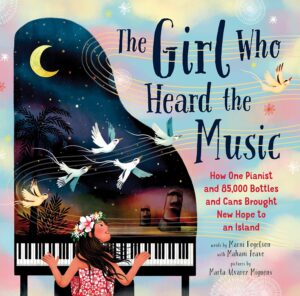
 

Amazon Cover

BOOK BLURB ON AMAZON FOR The Girl Who Heard the Music

Imagine living on a tiny island more than a thousand miles from any other inhabited place! That’s where a girl named Mahani lived―on Rapa Nui, also known as Easter Island. Mahani grew up taking music lessons on the island’s only piano. She had the talent to become a great pianist, but pursuing that dream meant leaving the home she loved.

As Mahani toured the world as an acclaimed concert pianist, Rapa Nui stayed close to her heart. She knew the island struggled with problems like ocean trash and wondered how she could help. So she returned to Rapa Nui with a new dream―to build a music school! The unique building is constructed with recycled trash and has solar panels and a food garden. Now Mahani is helping build a more sustainable future for her island home―where the music continues.

The perfect choice for parents looking for:

  • Inspiring nonfiction about women making a difference
  • Stories about sustainability and saving the environment
  • Kids STEAM books.

MY REVIEW FOR The Girl Who Heard the Music

Do you have a young musician in your home? This non-fiction autobiographical children’s book tells the story of Mahani Teave (who co-authored this book with children’s book author Marni Fogelson, illustrated by Marta Alvarez Miguens).

The line that got me was “In the teacher’s living room, Mahani practiced the notes…until one day, CLICK!” I have seen that happen when a child is learning to read. And it is true for anyone who has found their passion, be it sports, music, painting, or embroidery. At some point something just clicks, and this, this is your love! It might even be Legos or gardening.

The pictures are beautiful, making it easy to fall in love with Rapa Nui (Easter Island). The book ends with two pages of facts, making this book a great choice for home schooling on a variety of subjects from how the Pacific islands were settled, to different languages, the the Moai (the Easter Island heads), to ecology, and social planning.
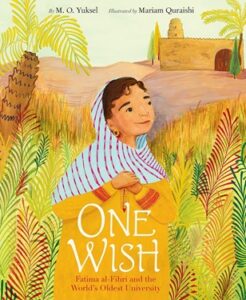
Amazon Cover

BOOK BLURB ON AMAZON FOR One Wish

Fatima had one wish . . .

Fatima al-Fihri loved to learn. She wanted to know everything, like how birds flew, why the sky was blue, and how flowers grew. But more than anything, she wanted a school for all, where anyone could study and become whatever they wanted, like teachers, scientists, and doctors.

As she grew older, Fatima carried her one wish inside her, through good times and bad. Fueled by her faith and her determination, she worked hard to make her one wish come true. For over a thousand years, Fatima’s one wish—her school—served students and scholars from around the globe, and it continues to do so today!

With lyrical text by M. O. Yuksel (author of In My Mosque) and stunning illustrations by Mariam Quraishi, this true-life portrait of an extraordinary Muslim woman shows the importance of never giving up on your dreams and how we all have the power to change the world for the better.

MY REVIEW FOR One Wish

The learned are the heirs of the Prophets, and the Prophets do not leave behind gold or silver coins but rather they leave behind knowledge. (Hadith 3641)

Some children crave learning; Fatima was once such child. More than that was a desire to have a place of learning for everyone. Thanks to growing up in a rich family who managed to survive a displacement and a short time as refugees plus a beneficial marriage, she was able to do something beyond wish. She built a university and a community center – one whose history and activities have continued from 859 C.E. to its integration into the modern Moroccan university system. A University impacting history and the world. She built with purpose and the world has benefited.

This biography picture book includes three pages of history and a glossary at the end. The pictures are colorful without being overwhelming.
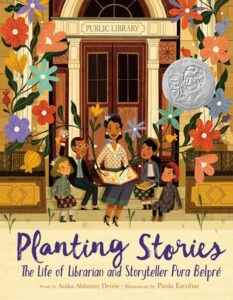
 

Amazon Cover

BOOK BLURB ON AMAZON FOR Planting Stories

An inspiring picture book biography of storyteller, puppeteer, and New York City’s first Puerto Rican librarian, who championed bilingual literature.

When she came to America in 1921, Pura Belpré carried the cuentos folklóricos of her Puerto Rican homeland. Finding a new home at the New York Public Library as a bilingual assistant, she turned her popular retellings into libros and spread story seeds across the land. Today, these seeds have grown into a lush landscape as generations of children and storytellers continue to share her tales and celebrate Pura’s legacy.

Brought to colorful life by Paola Escobar’s elegant and exuberant illustrations and Anika Aldamuy Denise’s lyrical text, this gorgeous book is perfect for the pioneers in your life.

Informative backmatter and suggested further reading included.

A Spanish-language edition, Sembrando historias: Pura Belpré: bibliotecaria y narradora de cuentos, is also available.

MY REVIEW FOR Planting Stories

Some people report things can’t be changed, then you stumble across a story like Pura Belpre who through one simple action following another introduced the Latinx community to the public library system in the 1920s, starting children librarians performing puppet shows, and publishing bi-lingual children books.

This book features many Spanish words mixed in with English. If you are reading this to your children and you have not studied Spanish for some time, you might want to practice before reading it.

The pictures are colorful, show representation and clothes appropriate to the times, and are fun. Paola Escobar does a wonderful job as illustrator.

You can make changes by planting seeds.

Flash: One Sunny Day

Photo by Johny Goerend on Unsplash

I love the window seat when flying on a plane. Living in the greater Seattle area involved clouds more often than not (only Anchorage Alaska beat us on cloudy days), and the chance to break through and get above them for once made me feel like I conquered the world even if it was a simple commute to Buffalo New York for our twice-a-year meet-up of all the virtual employees at World-Connected. Being the manager of the western seaboard meant I had extra in-person meetings with the big-wigs. I couldn’t skate by in a nice top and pajama bottoms from home, even if half of the meetings would be virtual break-out groups with my team members on satellite delay.

The rain against the window on the runway as we coasted into position quickly turned into a gray wall of fluff streaking water as I was pressed against the seat during our initial climb. Light flickered in-and-out the higher we climbed; the cloud varying between cotton ball white and melancholy charcoal as we passed through mountains of atmospheric moisture. Until, finally, we leveled out with the world below stretched as far as I could see a rolling landscape of white hills and a brilliant sky of blue except for the burning ball of brilliance far too close to look at long.

I won again. The cloud cannot hold me down! I smiled at my whimsy, but the truth is, I also felt it in my soul, like a release from gravity.

I should probably move away from a place where clouds cover the sky over sixty percent of the time, but I had scored a house secured between three major cable carriers and also came with a satellite dish in the backyard leftover from the eighties. It had only needed a little tweaking to get working, and with the generator I added, I never had downtime. My bosses loved it.

I saw a plane shadow race past below us, likely the one I will be using to return back home in four days. I half-lowered the window shutter at the request of my seat companion, who started snoring almost immediately thereafter even though we had a mid-morning flight. Pulling out a book on the ethics of generative AI from my smaller carry-on, I divided my attention between the clouds as we passed over the Rockies and work reading.

When we were passing over the patchwork quilt of the Midwest, where scrub-brush brown is broken by wheels of irrigated green crops, the light dropped, making it hard to read. The tradeoff of longer being mildly cooked by the nearby sun could not compete with the added difficulty for my self-assigned workaholic task. Annoyed, I looked out the window; it wasn’t even lunch time, though we were working against the clock with this passage from west to east.

No clouds above or below. The mid-summer heat dome had pushed the moisture up to Canada.

Instead, something passed slowly in front of the sun.

There was no eclipse scheduled.

And the object eclipsing the sun wasn’t disc-shaped.

(words 502; first published 8/16/2026 – created for Writer Workshop Prompt: Set your story in or on a car, plane, or train. Let the journey, destination, or confined space shape the characters and events. – word limit of two pages or less)

Editing Rant: Polish, Not Paint

Photo by Susan Wilkinson on Unsplash

The job of an editor is to polish a story, not paint their own. To take out the rough edges, to bring out the shine, to make flaws into items of interest, to shape the rock into a gem. When editing (developmental), you don’t decide the science fiction should be a romance, but you might want to point out to the author there was a romantic element buried in the story and it would work better if these two romantic tropes were added among the science fiction tropes. When editing (line), you don’t get to decide that the choice of French is wrong for the magic system and substitute in Latin. When editing (proofreading), you don’t decide that the English/UK version spellings like axe, judgement, and grey make more sense than the American spellings of ax, judgment, and gray even if the story is set in the UK, if the book is written by an American to be published in America.

It’s their gem you are polishing, not yours.

An example I run into a lot is repeated sentence starts. I have dropped this line in more than once into developmental and line editing: “You have three (or more) sentences in a row starting with “She” (or “He” or “It”), sometimes this is wanted to create a beat or an emotion. I am just checking in on this one. You don’t have to change anything, but I wanted to make sure you are aware that you are doing this repeat.”

Many times I don’t feel the need to point out the repeat sentence starts, when it is clearly in the brawling or emotional breakdown stage where someone would be repeating themselves or being very choppy. “I didn’t know. I couldn’t. How did that happen. I did it. I can’t imagine.” These are obvious about being part of the story.

But other times, well, the author may want the repeat, or she may not be aware of the situation (half the time they are not). Hence making a note; but I don’t get to say “delete this.” It isn’t my story.

I am a writer, at least I write things. For non-creators, I’m told editing is easier. But for me, I must remember at all times it is their story, not mine.

If you are an editor, put away the creative paints and only bring the polishing cloths to the editing table. You are doing a different task than writing and need different tools.

If you are a writer, remember it is your rock being made into a gemstone. You are the primary creator. Realize that a lot of the suggestions are good, even great. They will make your gemstone sparkle and shine. Sometimes it will hurt as they burnish an edge, sanding down an area. The process isn’t easy. Still, don’t let anyone paint over your voice; it is your story being told.

Polish, not paint.

Only allow polish if you are a writer being edited; only polish if you are an editor.

Does that make sense?

Writing Exercise: What is Missing?

ID 24450426 © Dirk Ercken | Dreamstime.com

I mentioned in the Editing Rant: What did you see? (7/14/2026) “readers have an easier time of visualizing what is there rather than what is removed.”

But as a writer, you often need to write about something that is no longer there. A clue that went missing, something missing that becomes a clue. It could be someone missing or the loss of the senses of smell. The Point of View character could be blindfolded or temporarily deaf. Someone might have been pickpocketed, or “Dude, where’s my car?”

WRITING EXERCISE: Write about a void. Something is missing: an object or a person or something that had been registering on one of the senses. Per normal, this is an exercise. Keep it under 500 words and post below if you want.

My attempt: Silence of the Forest (7/19/2026) is based on the lack of sound. This is a device often used in fantasy: The FoResT GOes siLENT!! But often you don’t “hear” it go silent because nothing was heard before. Yes, the characters might have been talking, but the readers haven’t been told about all the noise the forest is making all the time. The fact it went silent isn’t impactful. I wanted to see how it would work if I built sound into everything within the story. How do you think it worked, specifically in relation to help the audience hear the forest go silent.