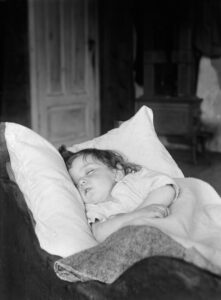
Photo by Fylkesarkivet i Vestland on Unsplash
In the early part of the century, I participated in a sleep study for the University of Pennsylvania Medical Center. First I got hooked up to a machine for two months while I didn’t have caffeine or alcohol (no stimulates or depressants) and proved I was healthy. Then I had two weeks in-lab with a group of seven people where we did logic tests, physical tests, and driving tests for graduate students. Ever since my turn as a lab rat (FOR SCIENCE!), I’ve been fascinated with sleep, so when I saw the new study about micro-naps I perked up.
We all have experienced Sleep Intrusion, where sleep or sleep-like effects happens when you are awake. (Abe) Blank stares (are you still there? ask the person across from you) and little head jerks (while driving at night, hour fifteen of the trip) are common in a world of electric lights and two-jobs.
How dare sleep intrude on your wake time? Doesn’t it understand that wake and sleep are two different states.
Yet another false dichotomy in the world.
What most people have seen and kind-of understand are microsleeps (lasting under a minute, usually only seconds) where we lose awareness around us, hypnagogic jerks (the muscle twitches of sleep), and local sleep where only parts of the brain fall asleep. The involuntary muscle twitches is different from the head jerks while driving when your brain registers that your head is falling down.
Local sleep, where part of the brain shuts down, is much more common in animals. For example dolphin pods may sleep with one eye closed and half the brain asleep to keep an eye out for predators, then switch eyes and sleeping brain.
I got to witness this in action during the sleep study.
The group of us came from all walks of life. The one who had served as a military helicopter pilot had the least loss of mental skill and physical reaction of everyone in the group; he explained he had spent his whole life having to wake up and do something complicated quickly. Part of the study was taking DNA, and I know they were testing to see if it was nature or nurture giving him his superpowers of anti-sleep intrusion. The teacher, on the other hand, arrived sleep deprived and with a stack of papers to assemble her plans for the upcoming school year. She was looking forward to her “free time.”
Once while we were doing the driving test, she became paralyzed. Half of her body couldn’t move. Fortunately a doctor in the room was doing our temperature checks (rectal) and went to look her over. Half her brain had fallen asleep. She could talk, but one eye was close and half the brain was getting some desperately needed rest.
They woke her, the part that was asleep, because of what the sleep study was doing. I wonder if that incidence is a footnote in the studies which were drawn from the experiment. The UoP continued the experiment for years, rotating groups of seven people for two weeks in that four-room area. Anytime I see a “University of Penn Medical Center” sleep study and see “two weeks,” especially with a “three-day” subsection (which is where we either got no sleep, 1-hour sleep, 2-hour sleep, etc up to 10 hours sleep for the lucky (not us) control group), I go “I was part of that!” Two of the articles in the bibliography indicate just such a study.
In a new study which I was not part of, scientists studied the brainwaves of sleep. The normal wave of sleep, and the wiggly lines of REM.
The four states of sleeping: Stage 1 (going to sleep); Stage 2 (relaxation, change in body temperature); Stage 3 / Deep sleep (where the body heals and grows); Stage 4 / REM sleep (dreaming, and body is temporarily paralyzed – or should be to prevent reactions to the dream). Stage 1-3 have nice slow waves; Stage 4 is active. Our average sleep cycle lasts about 90 minutes, but range during the night from 70 to 120 minutes – with the longer cycles happening later in the night/early in the morning when REM sleep plays more of a role. (Suni)
One of the tests in my sleep study had us lay down alone, after we had been sleep deprived, to find out how quickly we would drop into sleep and what type of sleep. They would wake us up as soon as they confirmed sleep – usually 2 to 5 minutes. If we hadn’t drifted off in 20 minutes, they called in the next person.
Earlier in the study, our brains dived for deep healing sleep; later, our minds were desperate for dream sleep. Fortunately we did not pull the “no sleep at all” portion of the test; though three days three-hours of sleep a night is no joke after a week of only five-to-six hours and absolutely no bright lights to reset the body’s circadian rhythm. But dreams got VIVID toward the end.
This has proven true in other experiments done elsewhere. Initially, the brain will go for the healing sleep, just like most people do in normal life. The first two or three cycles of nightly sleep are concentrated on healing sleep, with each round spending a little less time in healing and a little more time in dreaming. The brain climbs up to Stage 1 at the end of the cycle, takes a quick inventory “any loud noises, do we need to go to the bathroom”, then lowers into Stage 2 and continues, with the last cycle of the night being mostly dreaming. If you don’t get enough healing sleep, you feel beat up.
For one experiment, they woke up people every time their body entered REM. For those poor souls, their bodies started skipping right to dream sleep after a few of days.
We need both. Body healing and mind healing.
Anyway, enough about my experiment and things that have been out there for the last twenty years.
New for 2024 – with new technology – researchers were able to chop up the brain waves down to microseconds and asked the computer if the person was awake or asleep. Now, sleep has the beautiful waves for Stages 1-3 and “wake-like” registration during dreaming. But what they found is the brain has micro-stages of being awake in various parts during sleep and micro-stages of being asleep while awake. “(S)mall regions of the brain can momentarily ‘flicker’ awake while the rest of the brain remains asleep, and vice versa from wake to sleep.” (Cerf)
This isn’t like the afore mentioned microsleep of nodding off at the wheel, but a natural flicker happening day-to-day, moment-to-moment. A “you got sleep in my wake take; well, you got wake in my sleep time.” Sleep and waking overlap constantly, in tenths and hundreds of a second.
Another experiment (from the 2016 by Brown University) tested people falling asleep in unfamiliar places. The “First Night Effect”. During the first night in an unfamiliar place:
“Research shows one brain hemisphere, usually the left, remains more alert throughout the night, subtly monitoring our new environment for threats to keep us safe.” (Gresh)
Basically the left side stays on Stage 1 of sleep, monitoring things for safety, and the right side does a normal sleep. An interesting evolutionary compromise leaving a traveler very tired the next day, but if you return to the same hotel room the next night, the brain has the environment on record and a both parts of the brain get the needed sleep. But road-tripping, with a different room every night, is exhausting as only half a brain’s sleep is available. When traveling, be sure to take into account the First Night Effect.
Sleeping is worthy of Geeking between First Night, Stages of sleep, micro-sleeps, and all the other complications. You think something that takes up nearly a third of our lives would be less complicated…or maybe not. A third of our lives is a long time.
Bibliography
Abe, Yoshinori (reviewer). “Understanding Sleep Intrusion: How the Awake Brain Tries to Nap.” Ubie Health. 21 May 2026. https://ubiehealth.com/doctors-note/exhaustion-involuntary-twitching-awake-in-tries-4752q5 – Last viewed 11/6/2026.
Cerf, Emily. “Scientists find that small regions of the brain can take micro-naps while the rest of the brain is awake and vice versa.” University of California. 18 July 2024. https://www.universityofcalifornia.edu/news/scientists-find-small-regions-brain-can-take-micro-naps-while-rest-brain-awake-and-vice-versa – Last viewed 11/6/2026.
Gresh, Rachel. “Why You Don’t Sleep Well in an Unfamiliar Place.” Interestingfacts.com. Undated. https://interestingfacts.com/first-night-effect-sleeping-in-unfamiliar-place/ – Last viewed 11/6/2026.
Hammond, Claudia. “Microsleeps: The naps that may only last seconds.” BBC. 31 January 2024. https://www.bbc.com/future/article/20240130-microsleeps-the-naps-that-may-only-last-seconds – Last viewed 11/6/2026.
Koch, Christof. “Sleeping with Half a Brain.” Scientific American. 1 September 2016. https://www.scientificamerican.com/article/sleeping-with-half-a-brain/ – Last viewed 11/6/2026.
ScienceDaily. “’Sleep Debts’ Accrue When Nightly Sleep Totals Six Hours or Fewer; Penn Study Find People Respond Poorly While Feeling Only ‘Slightly’ Tired.” 14 Mary 2003. https://www.sciencedaily.com/releases/2003/03/030314071202.htm – Last viewed 11/6/2026.
Suni, Eric. (Reviewed by Abinay Singh, MD) “Stages of Sleep: What Happens in a Normal Sleep Cycle?” Sleep Foundation (Yeah, this is a sales site.) 25 July 2025. https://www.sleepfoundation.org/stages-of-sleep – Last viewed 11/6/2026.