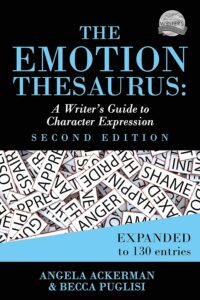
Amazon Cover
The Emotion Thesaurus: A Writer’s Guide to Character Expression (Second Edition) by Angela Ackerman & Becca Puglisi
BOOK BLURB ON AMAZON
The bestselling Emotion Thesaurus, often hailed as “the gold standard for writers” and credited with transforming how writers craft emotion, has now been expanded to include 55 new entries!
One of the biggest struggles for writers is how to convey emotion to readers in a unique and compelling way. When showing our characters’ feelings, we often use the first idea that comes to mind, and they end up smiling, nodding, and frowning too much.
If you need inspiration for creating characters’ emotional responses that are personalized and evocative, this ultimate show-don’t-tell guide for emotion can help. It includes:
- Body language cues, thoughts, and visceral responses for 130 emotions that cover a range of intensity from mild to severe, providing innumerable options for individualizing a character’s reactions
- A breakdown of the biggest emotion-related writing problems and how to overcome them
- Advice on what should be done beforedrafting to make sure your characters’ emotions will be realistic and consistent
- Instruction for how to show hidden feelings and emotional subtext through dialogue and nonverbal cues
- And much more!
The Emotion Thesaurus, in its easy-to-navigate list format, will inspire you to create stronger, fresher character expressions and engage readers from your first page to your last.
MY REVIEW
Got the 2nd edition
A good intro to how to expand beyond the typical – “he looked angry at my request” and “she growled in frustration as she worked”. Why are you TELLING me what they are feeling instead of SHOWING me.
“Once I voiced my request, his eyebrows clashed like blades on his forehead while his mouth’s edges slashed down.” “Her voice lowered as she continued to work on the seemingly impossible task until only a growl remained.”
If you actually are stating the emotion – grab this book for suggestions. With over 130 emotional states described with hints on how to express them, your characterization should pop.
The opening pages do a fairly good job of explaining the original intent of and how to use this reference book. I picked it up for instructional purposes. As an editor, I am constantly trying to explain to people how to “show not tell” – but the challenge is doing so without putting my voice into their story. I’m looking forward to using the suggestions provided with the newer writers I work with.