Not Today. What happens when you really, really don’t feel like writing?
Well, what happens on your dayjob when you really, really don’t feel like dayjobbing? You go to work, don’t you.
If writing is your dayjob, then you don’t get to wait for the muse to strike. You pick him or her up and sit her down at the computer and get to work.
But what happens if writing is your second or even fifth job? What then?
Two questions – how much do you want it to be your dayjob, and do you have ANYTHING left in the creative stores?
I recently have been on a blogging run, 18 days in a row catching up on missing blogs. Then dayjob pulled a 13-hour day and I had NOTHING. I tried, I really did – but no-braining was happening. I looked at the 18 day streak and, as much as I hated it to end, I forgave myself the need to sleep.
John Hartness facebooked a “no interest in writing day” and many authors – some dayjobbers and some writing-primary-income – responded after his initial response to himself – mortgage doesn’t give a single fuck about what I feel like today: doing the book bible because don’t have the creative in me today; I figure some days I hate drafting divorce papers for my lawyers and some days I hate drafting books for my publisher – if I want to be taken seriously as a writer, I got to do it whether I feel like it or not; I find writing in chunks works – just get 500 done … and suddenly at 4,000 (or at 500, but, hey, 500!); playlists help.
I know I posted a lot of “don’t beat yourself up,” especially during the pandemic. That is taking a lot of energy and creatively away; basically we are all in mourning for what we used to be.
At the same time, you want a job as a writer, you write.
To balance all the self-care and forgive yourself, today is the just write day.
WRITING EXERCISE: Write 500 words. For a blog, a scene for your WIP, a character background for your D&D group. Doesn’t matter, get the words down today.
My attempt: 399 words here plus 101 words for a different blog.
I hope that in the middle of NaNoWritMo you have been taking care of your Maslow’s Hierarchy of Needs. Because it is awful hard to write (a Self-Actualization product) when your Physiological and Emotional needs aren’t being met.
If you are not familiar with Maslow’s Hierarchy of Needs, it goes as follows:
Bottom layer 1 – Physiological Needs (breathing, water, food, excretion, sleep) Bottom layer 2 – Safety Needs (Physical safety like shelter and clothes and health; Mental safety like steady income, security of body, and security of those under your care) Bottom layer 3 – Belonging (Friendship, family, sexual and/or emotional intimacy, sense of connection) Top layer 4 – Esteem (Confidence, achievement, respect for self and others, enjoyment of arts) Top layer 6 – Self-Actualization (Morality, problem-solving, lack of prejudice, creation of arts)
While for most of NaNoWriMo, writers are reminded time and again not to let their Physiological Needs slide – it’s hard to write hungry or without sleep – that is not the only layer which needs to be in place to write well.
Today, being Thanksgiving in the United States, is a day of Belonging so let’s look a little at that. I think this is where most of writer’s block comes from. Argument with significant other, parent or child being sick, depression – anything that breaks or endangers the ties of connection taking the energy away from the higher layers where creativity lives and bring it down to the more important needs to survive.
Just like a child isn’t going to learn while hungry, or cold because of no winter clothes which fit, or worried about being taken away from their parents, a writer isn’t going to do their brain-best if they cut back on their sleep, worried about their day-job, or hasn’t had a hug in a while. Humans need these things.
Now you can skip around the pyramid some – you can go hungry for a couple hours if you enter The Zone. Sometimes health is never going to be completely met because of disability. But don’t beat yourself up if you don’t write too much today because your family is 1,000 miles away (like mine is) and you are missing them. You look at all that free time and go “why can’t I write?!?”, but emotional fragility undermines your efforts. I am going to go talk to my mom on the phone for a while. That should help me.
To find out more about this topic check out Liana Brooks post: http://lianabrooks.blogspot.com/2016/02/maslow-vs-deadline.html. The takeaway comment which hit me the hardest “The secret to hitting your deadlines in the chaos is to recognize your needs, and meet as many of them as you can.”
WRITER EXERCISE: Take care of one of the three bottom layers today and tomorrow share below how it changed your approach to writing – and maybe not just word count, but your enjoyment of the creative process or quality of the creative process.
They say, “Dream … but not too big. Reach … but not too high. Shine … but not too bright. Think the impossible … as long as it is in black and white.”
I know I often talk about limits and taking into account reality. But also, REACH – DREAM – THINK!
Don’t break yourself, but don’t let them break you either.
Totally in love with this Todrick Hall song from his Straight Outta Oz series (yes, it features some of the members of Pentatonix) – the images created by the lyrics are perfect.
Many characters in books, especially urban fantasy, spend a lot of time in bars. Fantasy characters gather at the pub. Science fiction characters trade exotic liquors, or figure out how to moonshine with extra parts from the ship’s engine. One of the stock mystery characters is the noir detective who never climbs out of the bottle until it is empty.
Ms. Sarah Gailey wrote an article from Barnes & Noble Reads focusing on Hagrid’s drinking problem in the Harry Potter series.
Substance abuse, impacting nearly 1/3 of all Americans and even higher in some demographics, is mirrored from reality to literary works where many people problem-solve by creating a thought experiment. What would have happened if someone confronted X sooner? What hints did they give which their friends should have seen?
Have you ever created a character with a substance abuse problem? Did you mean to create the character with a drinking problem or did it evolve? What has driven them to their issue?
Hagrid’s backstory gives insight to why he might need to self-medicate his depression through numbness. Ms. Gailey breaks down a character study for him. Found out more at – The Literary Art of Drunken Secret-Telling by Sarah Gailey (May 2, 2017 at 1:00 pm): (UPDATE: Link broken as of 10/16/2023 – so 6 years later)
Do you think too much drinking is shown in TV, Movies, and Books, or too little, or does it appropriately match rates in reality? Comment below about drinking and/or substance abuse in your present WIP, present read, or present video series binge.
Image courtesy of Stuart Miles at FreeDigitalPhotos.net
Don’t quit the day-job. In the middle of tax season (well, day 58 of 105, so a little over halfway), it is so, so tempting. I love editing and writing and have been doing both consistently – mostly consistently – since this blog started back on November 11, 2011. And even before then. February 2010 I won the short story competition for ConDFW (NOTE from 4/26/2024: ConDFW has been discontinued. It never recovered from the 2020 cancellation because of COVID.) . And looking for that short story, I stumbled across a dense book idea from 2002. And peeling back even further, I’ve been writing something for someone since middle school, publishing something somewhere for most of my life.
Last year about this time, Chuck Wendig wrote an article On Day-Jobs and Starving Artists. His advice, don’t quit the day job. At the time, there had been a “live your passion” Tweet going around urging people to Go-For-It. But Wendig raises a very good point, if a passion is to become a job, then the job needs to be prepared for. It’s not enough to LOVE something. One needs to become skilled at it. Know the industry. Be willing to do it day-in day-out – while sick, or emotionally devastated, or tired. All.the.time. And skilled enough at it to do while sick, tired, lacking heart, just like a day-job (which is what the passion becomes if you quit your day-job). Approach the situation like you would prepare for a new career, making a passion into a career requires preparing for it like it is a new career.
So if you (or me) is thinking of quitting the day-job to Live Your Passion, there is a catch to pulling a sixties-hippy moment.
Be ready to not just Live Your Passion. Be sure to Survive with Your Passion.
Which is why I’ve been working developing the skills and lifestyle for the new career for going on a decade. You’ve seen a lot of my research and skill development in this blog. I’ve gotten things settle in well at this point. Still, it isn’t a true career because it barely pays for itself, let alone the bills like food and roof. Time to look at a few more Cool Blogs with additional advice related to Day-Jobs, Income, and Writing if I want to get to the next level.
Well, just burst my bubble. I want to stick it to “the man”. What do you mean I got to work this like a retail job? Where is the passion of creativity? Ah, there is the rub. You can’t just pursue your passion if you want to eat. Someone has got to provide you money for it. Which means sell the passion. Artists sell covers, writers books, musicians performances.
Her list goes on.
Mr. Ferris has a list as well, “12 Things You have to Give Up to be a Successful Writer.” Wait, I want to Live My Passion, not deprive myself. But I do want to be successful as a writer, not just survive. I like eating! What is on this list?
There is no “participation trophy”. Time, skill, and hard work does not mean success. And for that off-chance at success, you will give up vacations, hobbies, friends, (vial of own blood?), … – that is what the blog boils down. The post was written for laughs but holds a lot of truth.
No participation trophy means no automatic success and, more importantly, no paycheck just for showing up. Not like a day-job.
Going through my bookmarks of saved articles, I’ve found a third list. A nice short one: 8 Smart Ways to Supplement Your Fiction-Writing Income. The blog posts start off by saying “most authors don’t make a living off their writing”, over half of traditionally published and “almost 80 percent of self-published authors make less than $1,000 a year (from writing)… Because of this, most authors stay at their day jobs to support their families.” It doesn’t mention what the author percentages are for a living income.
$1,000 is a stupid breakpoint for “making a living”! To have it be a day-job, you are looking at least $14,000 a year – which is an equivalent to a 40-hour a week minimum wage job – only a writer is more like 80 to 100 hours for a week if full-time.
Well, what do they recommend? Yep, yep. Okay, three of my nine gigs that I do outside of writing show up on the list.
What do I do? Tax preparation, acting, editing, website programming, politician, product reviewer, newsletter support, long-distance bookkeeping, and summer-camp support. Yes, I did each of these professionally (for pay) in 2019 at least once, thank you for asking. The tax preparation, of course, is the day job paying the majority of my bills. But to free up time for writing, I gig the rest of the year for food. It’s a price I’ve chosen to pay to go after my passion.
It means I am often mentally exhausted before I start working just trying to figure out what I need to attack next.
It means I fall down on a gig sometimes because I have to do something for another gig.
It means no insurance.
I don’t recommend it if you have a family to support, children who depend on you, a spouse you want to stay on speaking terms with. (Return to the list of things you give up to be a successful writer and the fact that there is no participation trophy – no guarantee of success.)
Just how bad is writing income?
Merritt Tierce wrote about “I Published My Debut Novel to Critical Acclaim – and Then I Promptly Went Broke.” She quit her day job when her first book was published. She hadn’t start writing the second. One book does not keep a household alive for a year, let alone a lifetime. She goes into the challenges she faced because she bought into the false myth of follow your passion, everything will fall into place.
No, everything does not fall into place.
“The reality is that somehow you have to make money,” Ms. Tierce writes.
Every writer I know, as soon as the first book has been sent in starts the second. One of my authors (who has an amazing day-job AND a husband who supports his efforts), just sent me his 2020 schedule – Book 2 Series 2 finish draft 1 (started over Christmas/New Year break), book 1 series 1 complete the edits and return (the one I am presently working with him on), book 3 series 1 start draft 1, book 2 finish draft 2 and send in, complete proofreading and further edits on book 1, then in April … Yes, working three books simultaneously. Total goal for the year – another three books, just like last year. Again, he has a day-job. He sells well; it pays for his convention travel.
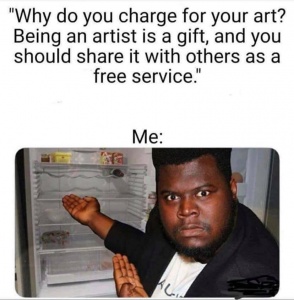
I recently had an artist friend post a meme:
My comment to the FB post? “Hey bub, being healthy is a gift. You should give your salary to charity.” (A couple members of her family are disabled, the types of invisible problems where everyone goes “just suck it up and get a real job,” since they are functional 2 to 3 hours a day. (o_O) You know, the time when they actually function well enough to go into public to shop or make doctor appointments.) She gave my response a heart-like.
Why does following your Passion have no Income reward?
Because it is a passion, people will accept any amount of money to do it. And the people who make money off of artists, dancers, singers, and writers know this.
If throwing an event, the venue and booze isn’t going to lower their prices. The only place to keep prices low is … (wait for it) the feature presentation – the draw for the actual event. So the event producers pay the artist gig level costs and pocket the rest.
Because, as a Duke Study shows, “workers’ passion is increasingly used as justification for their exploitation in today’s labor market.” (Voynovskaya 2019) Our culture embraces the myth of passionate work, telling us to find “our life’s calling at work”, and then turns around and says because we have job satisfaction, enumeration doesn’t have to pay as high. Bosses love passionate people who will work long hours and weekends, for little pay.
Why can’t we be passionate and make a living wage? Who is telling us to “Live Your Passion” and why?
Teachers are told to be passionate, cooks are told to be passionate. Heck, the cashier at the grocery store is told to be passionate about their job.
My take-away to all of this, I’m not quitting the day-job anytime soon.
But Mr. Wendig did have another point.
When should you seek your passion?
Now. Right Now.
Not tomorrow, not next year. Now. Work on it; study it.
You owe it to yourself. Don’t live your passion for others. Live it for you.
Image courtesy of Serge Bertasius Photography at FreeDigitalPhotos.net
Just don’t do it full-time.
Until you are ready. And it is okay to never be ready. You don’t need to eat Chocolate Cake every day to be passionate about it. Part-time and holidays is just fine.
I guess I will keep the day-job a little longer. But I still am going to Live My Passion.
I hope this blog helps you figure out how to live yours. Flip through the Bibliography below for more details.