
Image acquired from the Internet Hive Mind
Image acquired from the Internet Hive Mind

Image acquired from the Internet Hive Mind

An updated picture of Ötzi, alongside the previous reconstruction. Image: © Max Planck Institute for Evolutionary Anthropology (Bridge)
O is for Ötzi and the subject of today’s Geeking Science. One of the best aspects of science is revisiting old knowledge with new skills and techniques to get a better image.
Our first view of Ötzi was in 1991 when German hikers discovered him in the Italian Alps.

(Ötzi, while still frozen in the glacier, photographed by Helmut Simon upon the discovery of the body in September 1991 – Fair use,
Extraction from the melting glacier included clothing (made from leather and hide) and hunting tools (axe, flint knife, and longbow). (Bridge) And was done … poorly. Initially, the approach was to remove a cadaver of some poor mountaineer who had the bad luck to die in the past decade on the glacier. Ice axes and a pneumatic drill got the body out of the ice, breaking the longbow among other archeological nightmares. (Wikipedia)
The first change of status happened when Konrad Spindler dated the body based on the copper axe to be “at least four thousand years old” a couple weeks later. (Wikipedia)
Later carbon dating from tissue samples of the corpse and carbon-based items found with him place it at 5,000 years. Further studies give a 2 out of 3 chance of death between 3239 and 3105 BC. (That is a 134 year window.) (Wikipedia) Each dive into Ötzi’s body, with better techniques and tools, gives better information. From eyeballing a body by untrained hikers to carbon dating a 150 year window about five thousand years ago.
This is true about nearly every discovery associated with Ötzi. From white hairy hunter-gatherer man who fell into a glacier, to the present view of a balding man of agricultural descent (though presently a hunter), with tattooed dark skin (about the shade of the Mediterranean), who got ambushed, but escaped to run home until he died on his journey back.
In 2001, an “X-ray examination revealed an arrowhead lodged in his left shoulder, suggesting that he likely bled to death”. (StudyFinds 2023)
Fig 1. Overview on the Iceman’s Health Problems – unknown source for picture as the connecting website is gone
While it looks like Ötzi had a bad life, he died in his mid to late forties. By mid-forties most modern people, even without an active lifestyle such as hunting, have back pain, bad knees and hips, some stomach problems, a couple of cavities, and likely a head injury of some sort – from dodgeball as a kid. The healed rib fractures is interesting; he lived long enough to recover from broken ribs. I wondered who helped him.
In 2003, Nerlich et.al. took a scraping where previous examinations showed a possible deep stab wound. They weren’t sure if it was an injury from life or an insult to the body from being tossed around by a glacier and then being extracted from the glacier with ice axes and a drill. They rehydrated the tissue sample and the results show blood clotting (like a scab) progressed between three to eight days after the injury.
I wonder if a similar study has been done on the arrow head injury. We know there is a hole there, but how long was it there. These two injuries together paint quite a picture and very different from some hunter randomly falling to his death in a glacier five thousand years ago.
The writer in me want to know. Did he and a hunting partner get in a disagreement and Ötzi got stabbed in the hand and shot with an arrow while he escaped? Maybe a group of invaders had captured him and the arrow shot happened when he grabbed a moment to run away, after playing up his trick knee and bad back with the wily actions of an man who had aged long enough to need to live by his brains instead of just his brawn. Maybe he was the invader into other people’s territories who hunted him down for his trespass, an old man scent to test their security.
The more his body reveals to us, the more questions open up.
In 2009, a CAT scan combined with DNA analysis gave us his last meals included ibex game meat, goat domesticated meat, wheat (likely bread), roots, and fruits. He was found with provisions such as barley, einkorn wheat bran, and flax and poppy seeds. (Wikipedia)
In 2012, the first DNA genome pass was done. The DNA samples used were highly contaminated. From them, and a cultural bias toward white people in cold climates, drawings and presentations show Ötzi to be white skinned and hairy. The dark skin of the mummy corpse was attributed to the mummification process (never mind that most mummies studies are of Egyptians and … wait for it … people of non-“white” skin). (Hesman Saey)
Genes giving lighter skin tones didn’t drift in to humanity until nearly a thousand or two thousand years later. Humans started in Africa; and European-descent people tend to attribute light-skin happening MUCH MUCH later into the “distant” past than it did.
It happened “recently” on the genetic scale. Like the Egyptian Empire setting up along the Nile recent. Like after China had silk for over a thousand years already, recent. Like bricks and city states had existed for a millennium, recent.
Civilization, cities, textiles, writing, and history all pre-date “white” skin. Europe didn’t create the building blocks of humanity.
In 2015, using special photographic techniques, suspected tattoos, which had been hard to see against the mummified skin, revealed 61 tattoos. (Wikipedia)
In 2023, a new DNA study on Ötzi genome revealed much of what we know now. Part of it is better techniques for clearing up contamination. Part of it is a broader base of genetic knowlege indicating human migration. The Human Genome Project started in 1990 and, thanks to massive increases in computer calculating powers, completed in 2003 (with some outliers finally solved in 2022). (Wikipedia HGP) Techniques, knowledge, and calculation powers had improved by several multiples.
New information indicated his ancestors were likely Anatolian farmers (StudyFinds 2023) rather than hunter-gatherers. The dark skin of the mummy likely matched the skin color Ötzi had in life. Instead of flying grey hair in his forties, he was much more likely going bald. He had the DNA for type 2 diabetes, but his diet protected him from the genetic predisposition.
You got to Geek Science when it revisits and retests and reassesses what is known. The past lifting knowledge up, the present reviewing and improving, and the future built on a more accurate view of how the world works and where humanity came from.
Bibliography
Bridge, Mark. “Bald and dark like his mummy – DNA redraws picture of Iceman Ötzi.” History First. 2023 August 16. https://historyfirst.com/bald-and-dark-like-his-mummy-dna-redraws-picture-of-iceman-otzi/ last viewed 6/25/2025.
EurekaAlert! “Reanalysis of Iceman Otzi’s genome reveals dark skin, male pattern baldness and more.” 2023 August 16. https://www.eurekalert.org/news-releases/998276 last viewed 6/25/2025.
Hesman Saey, Tina. “A new look at Ötzi the Iceman’s DNA reveals new ancestry and other surprises.” ScienceNews. 2023 August 16. https://www.sciencenews.org/article/new-otzi-iceman-dna-ancestry-genome last viewed 6/25/2025.
Metcalfe, Tom. “Ötzi the Iceman may have been bald and getting fat before his murder 5,300 years ago.” LiveScience. 2023 August 16. https://www.livescience.com/archaeology/otzi-the-iceman-may-have-been-bald-and-getting-fat-before-his-murder-5300-years-ago last viewed 6/25/2025.
Nerlich, Andreas G.; Bachmeier, Beatrice; Zink, Albert; Thalhammer, Stefan; Egarter-Vigl, Eduard. “Ötzi had a wound on his right hand.” The Lancet. Volume 262, Issue 9380. 2003 July 26. https://www.thelancet.com/journals/lancet/article/PIIS0140-6736(03)13992-X/fulltext last viewed 6/25/2025.
StudyFinds (2022). “Farming made our ancestors shorter, scientists discover.” 2022 April 9. https://studyfinds.org/farming-made-ancestors-shorter/ last viewed 6/25/2025.
StudyFinds (2023). “Ötzi the Iceman had dark skin and was bald – New study rewrites ancient history.” 2023 August 16. https://studyfinds.org/otzi-the-iceman-dark-skin-bald/ last viewed 6/25/2025.
Wikipedia (HGP). “Human Genome Project. undated. https://en.wikipedia.org/wiki/Human_Genome_Project last viewed 6/25/2025.
Wikipedia. “Ötzi.” undated. https://en.wikipedia.org/wiki/%C3%96tzi last viewed 6/25/2025.

Meme from the Interwebs, basically public domain because of wide-spread distribution
With the present rapid changes, and even before, I often sent forward memes that crossed my path on Facebook for others to either enjoy or learn from. Recently, a few people have (RIGHTLY) called me out for not fact-checking things I was sharing. Two deeper dives have ended with me deleting the post; in another case, I didn’t have the energy to do the research – I think it was correct, but gut feeling is not enough – and so just deleted it.
For the Meme above, written by Qasim Rashid, I merrily forwarded it and then went, wait, I need to fact check it.
As someone who took a lot of Sociology in college (one of my two majors), I was fascinated by the statistical study which could happen because states legalized no-fault divorce at different times. As a result, scientists were able to run models to see if suicides rates impacted:
A duology where language and poetry meet with space opera science fiction – all the rich world of Dune and the language of Lord of the Rings.
Teixcalaan by Arkady Martine

Amazon Cover
BOOK BLURB ON AMAZON for A MEMORY CALLED EMPIRE
Ambassador Mahit Dzmare arrives in the center of the multi-system Teixcalaanli Empire only to discover that her predecessor, the previous ambassador from their small but fiercely independent mining Station, has died. But no one will admit that his death wasn’t an accident—or that Mahit might be next to die, during a time of political instability in the highest echelons of the imperial court.
Now, Mahit must discover who is behind the murder, rescue herself, and save her Station from Teixcalaan’s unceasing expansion—all while navigating an alien culture that is all too seductive, engaging in intrigues of her own, and hiding a deadly technological secret—one that might spell the end of her Station and her way of life—or rescue it from annihilation.
Arkady Martine’s debut novel A Memory Called Empire is a fascinating space opera and an interstellar mystery adventure.
MY REVIEW for A MEMORY CALLED EMPIRE
Worldbuilding, Characters, Plot, and … something not quite right? maybe? (spoiler area)
Or … wow, is my book club going to have a LOT to talk about when we meet.
Worldbuilding
Ms. Martine explores how language and cultural heritage drives a government’s, a people’s future. The City/World/Empire (same word/symbol) is the center of their own world, anyone not them is a barbarian. Poetry and story and art drives choices from encrypting letters to declaring war. Names, web-eye interfaces, and careful release of information combine to create the world of the City-Empire. Into this world comes an Ambassador from a mining conglomerate-colony-government, not of Empire descent – either herself or the people she represents. They have an alphabet, spin-stations, and inserts of mental scans. She is seduced by their poetry, but the ambassador is not them and can never be them.
The poetry dependence reminds me of Japan, and India, and Viking heritages. Rune or kanji for the language where one picture means one thing and a thousand things at the same time. A Memory Called Empire is rich in worldbuilding and I loved every moment of it.
Characters
These are people of Empire and Indigenous/the Colonized. The Ambassador both totally in love with the big, beautiful, brutal empire and its hundreds of years of culture and history – and totally tied to her upbringing where generations count at 14 – so around 300 years. She will never be Empire. Back home, her government strives to be just helpful enough that the Empire doesn’t try to fix them and useless enough to not be worth taking over.
Meanwhile the Ambassador makes friends with the locals and Ms. Martine hits pitch perfect the patronage and patronizing of people who earnestly want to help the poor barbarian navigate in civilization. Except Mahit (the Ambassador) isn’t as barbaric as they expect and they are not as civilized as they thought. The first thing they have to help her with is investigating the last Ambassador’s possible assassination.
Plot
So many strands weaving together. The murder investigation, the Ambassador integration into the political world, the Ambassador integration with herself, the empire sliding into the end of a reign with big unknown of succession, and the secrets the small mining government is holding very tightly to its chest. There are hints of love, sabotage, war, plus poetry structure impacting everything.
Overall, no matter what type of thing you read for, this book has it in spades.
So why didn’t I completely love it? (on to editorial analysis – if not your cup of teach skip it, also lots of spoilers here. If you like hyper analysis and have read the book, continue on.)
SPOILER START
I never really liked the main character. I emphasized, I understood, I sympathized … but liked, not so much. And she doesn’t change. Who she is at the end of the story is the same as the beginning. Don’t get me wrong, part of the story is “coming of age” and she does come of age. But she just becomes more “her” in the process.
And that is true about all the characters. No one changes, except to become more of themselves. Plot doesn’t drive them or twist them. When they enter a scene in the book, they leave with nearly all the same goals and drives intact.
In fact, the only thing that really changes is the Empire. It was pouring in one direction, roaring like a river, an ocean, to drown a quadrant in an aggressive acquisition/assimilation. The Ambassador manages to put a pebble into the bed of the river and sends it spinning off into a slight change of direction. Will it return to the old bed? That will be revealed in the next book. But right now, the Empire’s war horn is singing a different tune.
It’s weird to have a book with so little character growth. Instead of growth, we have character polish. Each character is shaped like a statue, not pottery – instead of adding clay, the author chips away the stone until only the character remains. Within the story, each strikes the other, creating facets along the fractures to become the perfect true-self gems. Mahit, Three Seagrass, Nineteen Adze, and Twelve Azalea all shine so … brightly … tragically … perfectly … by the end.
SPOILER END
(checked out through the library system – support your local library)
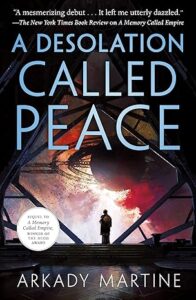
Amazon Cover
BOOK BLURB ON AMAZON for A DESOLATION CALLED PEACE
An alien armada lurks on the edges of Teixcalaanli space. No one can communicate with it, no one can destroy it, and Fleet Captain Nine Hibiscus is running out of options.
In a desperate attempt at diplomacy with the mysterious invaders, the fleet captain has sent for a diplomatic envoy. Now Mahit Dzmare and Three Seagrass—still reeling from the recent upheaval in the Empire—face the impossible task of trying to communicate with a hostile entity.
Their failure will guarantee millions of deaths in an endless war. Their success might prevent Teixcalaan’s destruction—and allow the empire to continue its rapacious expansion.
Or it might create something far stranger . . .
MY REVIEW for A DESOLATION CALLED PEACE
The star-spanning Teixcalaan space saga continues with all the poetry, politics, and personalities of the first installment. If you love epic science fiction, the likes of Dune but more accessible, you need this series.
The first story covered the fall and rise of an Emperor. Book two focuses on a possible war on many fronts. The depth of worldbuilding of the internal Empire politics of the military crossing swords with the greater politics of the Empire politicians, with their ankles being nibbled on by rats from systems which haven’t been conquered yet, while a new threat that is actually an EXTERNAL threat to the Empire as it devours the Edges of the World.
The first story is about poetry and culture; the second is about language and society.
There is no promise of a third book that I can find, but the unrest of the Empire and the City’s AI continues its threads in the second book. I fully expect the third book to focus on this … maybe … if there is a third book. Book one was published in 2019, book two in 2021. With that schedule book three in 2023 … and it is mid-2025 now. I want the third book of this series. I can see the shape of the poem – like Xanadu, unfinished yet the ghost edges provide structure leaving you hungering for more.
Each story has worked as a complete stand-alone. People sometimes ask if you would be willing to live in the world you love to read. This is a universe I want to inhabit.
(Read through Kindle Unlimited AND also borrowed from a library, support your local library system!)