Blog

Author Spotlight: Michael G. Williams

Amazon Cover

Around the time I wrote the Author Spotlight on Michael G. Williams back in 2017, my publisher asked me if I knew Mr. Williams and would be interested in editing a book by him. Seems the boss had picked up the series which I discussed in the blog post, plus would be publishing the last of the series. If I was available, he would assign it to me.

Oh my goodness, oh my goodness, OMG, OMG!!!! Squeal!

After I calmed down, I worded a reply – deleted that one as being way too fangirl – did another after I calmed down again. Finally I managed something along the lines of: “I have enjoyed his work and believe I can fit another book into my schedule.” Hit send on the email, then finger out and take a sip of tea. So professional. While quivering in excitement.

One book turned into two, then three, and now I am his go-to editor at Falstaff. (He does get some of his short work published elsewhere.)

My mantra when editing his work is “Don’t pull a J.K. Rowlings with Mr. Williams.” I want his work to be the best possible, which means he must get edited completely. Unlike Ms. Rowlings, whose books clearly had editing slack off as her editors changed into fans, I had to remain an editor. No matter how much of a fan I am.

And if I stay good, I get to see his work before anyone else!

That’s a big incentive to stay on the straight and narrow red editing line.

This year Falstaff Books put out three of his novels/novellas.

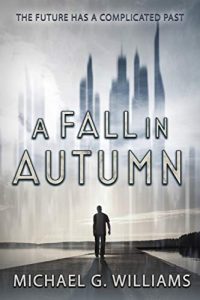
First one happened back in January 2019, A Fall in Autumn. In fact, it was Falstaff’s first publication of the year as well as the first book in a science fiction series about a detective. It’s amazing! The central conceit of the SF aspect is organic manipulation, not the typical military and spaceship story.

Second happened in June, Nobody Gets Out Alive, concluded the Withrow Chronicles. (I.touched.it. I.got.to.make.this.series.better.) The final cross-genre for the vampire series was War Chronicles. I had to dig deep to remember what I knew about the tropes of that genre, but I truly feel that the conclusion delivers on the promise of the series. Not an easy thing to do for a five-book opus.
Amazon Cover

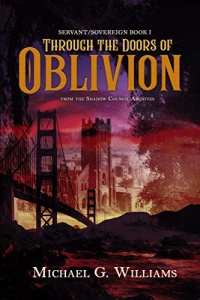
Third, and last one, published this year, Through the Doors of Oblivion, the first of a new series in the Quincy Harker/Shadow Council universe. This is perhaps his best story yet, mixing in so many of his passions. Mr. Williams love of San Francisco bleeds through every page. In fact, most of my editing felt like: “Pull back. This scene doesn’t fit this story right now. I know you love it, but save it for later books.” This time the urban fantasy focuses on witches vs. a demon, with a lot of the City by the Bay history thrown in.

Each book published this year had a different focus, a different sub-genre, and yet his author’s voice dances throughout even as the series voice and character voices adjust. He is an amazing writer.

And I get to edit him! (squeal, hands clapping)

Read his stuff. Give him a reason to complete the next book of the Fall in Autumn and the Servant/Sovereign series. I can’t wait to see them.

You can follow him at: http://www.robustmcmanlypants.org/perishables/

Flash: Dissolve

Image courtesy of renjith krishnan at FreeDigitalPhotos.net

I am actually one of the people who saw someone dissolve in November ten years ago. Just out of high school, I was working a big retailer, the one with the blue words and the yellow asterisk, putting together the salt and shovel display right near the door when I saw this woman walking out. It was late at night about two weeks before Thanksgiving and the Black Friday sales so it was just me, Billy, and the store greeter.

I remember her. Normally I wouldn’t. Thousands of customer walk by me every day. Normally I wouldn’t have even been looking at her pushing the cart out the door, but the salt bags were heavy and I stood a moment to take a breather. The woman had stopped near the doors, but just short of activating them to automatically open. Outside the winter chill was conspiring with the breeze to steal people breaths. I had done cart wrangling earlier and agreed with her decision to stop and pull on her gloves. The vibrant red coat, jeans, and boots weren’t going to be enough. In fact, she should had been wearing a hat, but no one really starts wearing those until it actually snows.

I remember her because as I watched, her image unraveled. About three cart lengths from me, she dissolved into nothing, leaving behind a cart full of gifts and groceries. Her purse had been tucked under her arm, so that disappeared with her leaving us no way to trace who she was and let people know she wasn’t coming home ever again.

I gasped as had the greeter. I looked over at the old lady, and she stared back at me.

“Did you see…”

I don’t remember which one of us asked, but both of us nodded before turning to look toward the doors.

Billy looked up about then and noticed the overflowing abandoned cart and sighed. “Jeez, I hope she doesn’t expect us to load the car after she brings it around. It’s fuckin’ cold out.”

I shuttered, staring at where a human being used to exist.

The old lady proved experience sometimes is more useful than muscle. “Do you think it was caught on camera?”

“Yeah, maybe.” I replied still unable to move my eyes from the new void.

“Go get the manager Dave.”

I still couldn’t move.

“Now. Go get the manager, Dave,” she repeated. “I can’t walk that far.”

The store night manager was in the back of the store helping accounting prep tomorrow’s payday. I blinked before turning my head back to the greeter.

“Now, please,” she said firmly, nodding toward pickup and technology.

I shuffled a couple of steps, walked the next few, and before I knew it I was running faster than my gym coach had ever made me run to the back of the store away from the impossibility. The horrific impossible impossibility.

It had been caught on camera. One of the few, so you might have seen it in the internet newsreels.

Just under half a million people worldwide, according to the statisticians, disappeared in a two-hour window. That sounds like a lot until you realize 7.5 billion people lived on the planet at the time. Less than a tenth of one percent had dissolved. Less than 1 in 1,000.

So we had a bunch of conspiracy theories from the kook-branch of humanity. These people never existed, these people were abducted by aliens, the people had been picked up by the government, just to name the saner versions. My personal favorite is we went through a giant amoeba’ space fart and had a mass hallucination. The Christians, especially the Mormons, thought the Rapture had happened and wondered why they had been left behind. The Mormons settled down when the count went over 100,000 and the rest of the Protestants were willing to listen to the scientists for once.

The scientists looked to find commonality, but didn’t find any among the people they could prove were missing because of the dissolving. Statistically they were spread across the planet, for example only 16,000 people were missing from the good U. S. of A. To put that in perspective only about 400 people were missing from New York City. More people died during those two hours than disappeared. Skin color, religion, age, wealth, health, gender, location, locomotion – nothing was what the scientists called “statistically significant”.

Actually, there was one bit. No one was touching the people who disappeared. In fact, no one was within two feet of the Dissolvees. This likely saved a lot of passenger on buses and in cars, but a few people traveling solo left cars driverless. Accidents worldwide were attributed to the Dissolving.

For the first year, once the scientist figured out about the closeness rule, people held hands … a lot. And a lot of babies were born the second year because people stopped sleeping alone. Things have calmed down a bit from the extreme closeness, but I think the breaking down of the personal space barriers created by modern technology is the best unexpected benefit we had. That and the wedding business still is booming which helps the insurance business.

Now a decade later, my retail years building to me being an insurance salesman, we still don’t know what happened. Lots of speculation, but no one knows the real answer to the most important of the burning questions: will it happen again?

Which is why I am standing in my old store staring at the space where the woman had dissolved  … her name was Shelby Lowe. We found the receipt she had taken out to show the greeter and had left with her groceries and traced her back on her debit card. She left behind three children and a boyfriend.

Those of us who were Witnesses all do this. Visit and stare. Not often, but my wife knows where to find me when I don’t come home from work on time.

(words 997; first published 12/15/2019)

Editing Rant: No One Is Stealing Your Idea

Image courtesy of Sira Anamwong at FreeDigitalPhotos.net

What a bundle of mess. No one is going to steal your idea – and even if they did, they can’t steal your story. Pirate it, sure, but only after it is written.

Okay, let’s just deal with some of the concepts and myths new writers and non-writers have.

If I share my idea, and you write with it, I get some of the money.

How many of you have been approached by someone with an idea for a story guaranteed to make a bundle? You do all the work, but the idea man gets half the cash in the deal. Writers don’t have a problem coming up with an idea – the problem is doing the work to bring the idea to fruition. If someone has an idea and wants someone else to write it and the idea man gets the money, that is call GHOSTWRITING. The Ghost Writer gets paid by the IDEA MAN who then owns the writing – usually the Ghost Writer is paid something up front and the balance on delivery.

So, no, if you are an Idea Man, you don’t get money for not working. I have several hundred ideas – some of which are partially fleshed out in flashes on this blog. And every writer I know is in the same boat with far more ideas than time to write them. We don’t need someone else’s idea, unless it comes with a paycheck.

I can’t share my idea; someone might steal it.

The bundle of irrational this myth has includes unwillingness to query an agent who might give the idea to one of their contracted authors and the unwillingness to bounce ideas off of people who might sit down and type out the seventy thousand words to make the idea a reality. Nope and nope. Again, all writers have ideas – no one needs to steal more, if they are a writer.

A writer, on the other hand, DOES need to bounce ideas off of people. So do this.

Now it may look like someone has “stolen your idea”. This is because there are times when certain ideas come to fruition in a society; the winner in the writing game in those cases is whomever writes those 70K words first and cleans them up for publication. Some of the books I’ve read have been like “dude, get out of my head”. I’ve never met the author, but they have taken one of the ideas that bounced around my head and wrote it out. I’ve seen at least four science-fiction military stories on school debt.

They all are different. That is the thing. No one can steal your idea, because even if everyone starts from the same point – you end up with different stories. With a writing group where several of the members were scared of someone stealing their ideas, I had everyone start from the same exact words: “He took to the list…” – the flashes ended up with a contemporary romance, a historical military fight, and a science fiction courtroom drama. Same exact starting point.

Pirating isn’t stealing.

Okay, this one someone really is stealing your story. Or maybe music or art. Fight it.

And you – you who goes “I don’t have the money to pay.” don’t do it! There is a TON of free stuff out there. Look at this blog – I have somewhere north of 600 posts about writing and free fiction. I’m making videos. I make memes to share. All I ask is my name to remain attached to the product if shared.

If you are a content creator and you pirate, shame on you.

The free stuff is free, but pay for the stuff that isn’t. Content creators need to eat. (Speaking of which, I got a patreon you can sign up for if you want to make sure I eat so I can continue making the free stuff. – https://www.patreon.com/ErinPenn)

Pirating is stealing. This is complete work, not an idea. Hundreds of hours. But this isn’t in the “someone will steal my idea if I share it” at all. Pirating is taking someone’s completed work and is a billion dollar CRIMINAL business. Criminals don’t like doing the thinking work, they just want the product to resell. So an idea – pheff – that is way too much effort.

Plagiarizing isn’t stealing.

This is another one where someone actually is stealing work. But again, the idea has been taken to fruition. The work has been done – they want to steal the WORK, not the idea.

And again, my fellow writers, don’t plagiarize. You think it would be obvious to grown ups, but noooo. 

And readers will find you out. Some of us read over a hundred books a year – someone is going to go … “wait a minute”.

Conclusion

At the end of the day, no one will ever steal an idea. Even people with similar ideas or starting points, when the WORK is put in, will create something completely different – because the creators are different.

There are CRIMINALS who will steal the WORK once it is complete, but ideas aren’t worth the paper they haven’t been printed on yet so the criminals don’t care.

In conclusion, bounce your ideas off of people to hash them out to the point you can do Butt In Chair, Hands On Keyboard (BICHOK). The WORK is what makes a writer.