Length matters when writing. To be marketable a story needs to be long enough, but not too long – fitting the genre and publisher requirements. Small presses make decisions on printing costs and book sizes allowed by print-on-demand companies. Novel or novella? Series, serial, or stand-alone? How much is the editing cost (usually by word count)?
How long can an anthology be and still break even? How many stories are needed to pull in a broad enough audience? How long can each short story be? Should flashes be allowed? How about a drabble?
Drabbles are exactly 100 words. Flashes fall under 2,000, usually hovering between 500 and 1,000. Short stories for anthologies start about 2,500 with 5,000 to 7,000 usually the sweet spot for little known writers and 10,000 to 15,000 for the anchor writers whose names appear on the front cover. Novellas, you are looking at 30,000 to 40,000, plus or minus 5,000 for the extreme ends. Novels are 70,000 for short and sweet genres like urban fantasy, romance, and mysteries; and 100,000 for the heavy worldbuilding speculative fics of science fiction and fantasy. Add 20% to these if a well-known author where a publishing house is willing to risk more editing costs.
The challenge is writing for a length, especially when your natural length is writing more or less than what is required. My natural length is short, really short. I’m naturally a poet – and not Norse Skald epics. I like tanka, a Japanese form of 31 syllables. I think in phrases, partial sentences. I don’t need to string together three to five sentences for a paragraph. My goal is nine to twenty phrases.
Flashes are beautiful.
And not marketable.
I’ve got to write longer. My natural length of 500 to 1,000 words, which means a short story is 10 flashes that need to hang together. A novella is 60 flashes and a novel 100 flashes.
Magical Words have had several episodes on writing to length. Here are some and their take-aways. Most focus on short stories since novel is the “assumed” length:
Coe, David B. “On Writing: A Novelist Takes on Short Stories”. 10/3/2011 –
On Writing: A Novelist – Writing a short story has different challenges than a novel: length, narrative aim, description (level) and method of writing. Mr. Coe states that to him, writing a short story is like writing a chapter in a novel. An internal arc, character growth, the driving of a reader forward, all remain the same. But the Method of writing is much slower. The articles does a good breakdown on the structural differences one finds in short stories.
Coe, David B. “On Writing: Short Fiction and Worldbuilding”. 4/1/2013 –
On Writing: Short Fiction – Sometimes, writing short stories of your characters can help flesh out ideas from your novels. These worldbuilding exercises (while necessary) don’t fit into the novel, as they are usually side stories or back stories, but, after the novel is done, they can be sold to anthologies as a marketing tool to point readers to your novel. They also can be used as special clues given to fans which follow you on patreon or your blog. (If you are one who normally writes large and want to scale down for short stories, David is you guy. His natural length is somewhere around 150,000 words. He approaches the problem of length from the opposite end as me. This is one of the great examples of each person’s writing style is different and what works for one person might not work for another.)
Jaffe, Stuart. “Publishing – Short Story Contracts”. 9/24/2010 –
Writing Scope – Is the story the right size for a short story? Does it have changing viewpoints, and are there subplots? The list goes on about red flags to look for when figuring if a tale which wants telling is a short story or a novel.
Martin, Gail Z. “10 Reason to Consider Writing for Anthologies”. 3/9/2016 –
10 Reasons – Focuses on why to market to anthologies. “#4. New Sandbox. A book is a commitment. A Short Story is a vacation.” and “#6. Test-driving publishers”, anthologies set up an environment where writers and publishers can see if they are compatible. “#9. Reusable content” – when the anthology rights revert (and be sure to have a time limit built in, industry acceptance is one year), the writer can publish a collection of short stories they had in various anthologies. The list goes on.
Massey, Misty. “Inviting A Crowd to the Party”. 11/5/2015 – http://www.magicalwords.net/misty-massey/inviting-a-crowd-to-the-party/
Inviting a Crowd – Limit the number of characters in a short story. A short story is a love affair; you don’t have to introduce them to the whole family.
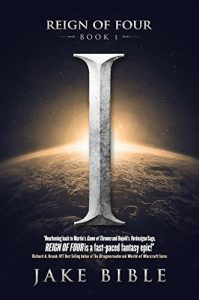
One of the most famous quotes about March is “Beware the Ides of March“. Ides being the middle of the month (every month, not just March), usually the 13th or 15th. I thought I would review a story on legacies, monarchies, and court intrigue created by pulp writer Jake Bible – you can find my author spotlight on him: here.
Millennia ago, planet Helios held a grand technological civilization. But the Cataclysm tore the land apart, and the survivors were forced to flee to the Six Stations, the artificial planetoids that orbited Helios. It did not take long for their society to devolve into a virtual medieval world, with barely enough technology to survive the harshness of life in space.
Out of this culture arose a line of monarchs called the Reign of Four. Alexis Teirmont was the First. He was a visionary, a warrior and a tyrant who was not immune to egotism, cruelty, and revenge. He would change the very fabric of the System. His reign would be remembered throughout history for both the good–and the bad.
MY REVIEW
I was at page 152 of 200 when I quit. This well-written book in the fantasy epic tradition is set in a science fiction environment. Brutal battles, vicious executions, harsh language, court intrigue, action, family, women second-class citizens (as appropriate for a culture based on upper arm strength for battle and work and a desperate need of children because of high death rates), etc.
This series has been compared with RR Martin’s Games of Thrones and Bujold’s Vorkosigan Saga series.
So I get why I didn’t really like the books. I just don’t do epic fantasy – the court intrigue and maneuvering, the sex scenes, explicit language and cursing, and brutal battles of mass combat – however well written and Mr. Bible does write well – just are not my taste. Usually because epic fantasy covering generations lack Hope; one cannot truly hope when one’s duty is to keep the dynasty marching on. While the stories may focus on an individual, the true focus is the rise and fall of society over time.
In many ways the best part of the book is that the danger against the individuals and the dynasty is really dangerous (battle, environment, intrigue). Urgency and control of agency for the monarchy drive each decision.
Mr. Bible does create a complicated world with stations and religion and social structure. Book III of the Reign of Four looks particularly intriguing. I think I will actually like the third Alexis. I haven’t liked either Alexis I or II – the first a man with vision but a cruel temper possessing him and the second a man possessed by weakness with only one area of steel. Just people I could not identify or sympathize with.
Because I didn’t like the focal characters, the language, how women are treated, and I have a hard time believing how the social structure stabilized for dozens of generations (a common device in epic fantasy), I gave up reading the story. I can see this book appealing to many people though.
Image courtesy of Pixomar at FreeDigitalPhotos.net
“Score!” Rashawn pumped his fists in the air upon seeing the Valentine’s Day candy had been marked down by half. One rose bud and several rose petals fell onto the cement floor. Horror quickly followed the initial triumph as all three guys stared at the strewn red.
“Um, I better take them.”
Rashawn quickly handed over the surviving flowers to Bobby. “Yeah, … thanks.”
The red hearts covered in silk, cellophane, and cardboard presented limited options, but enough to bring the boys to a standstill. “Maybe…” “Nah, doesn’t she like…?” “Stupid diet vegan …”
Bobby plucked the smallest heart available, offering only four pieces but each containing dark chocolate, coconut, or both. “I think with the bear, I can do this and a single rose.” He looked over the sorry bouquet one more time. “That will leave five good roses.”
He smiled widely at Doug, his eyes sparkling. “One for each year you have been dating Stephanie.”
“And if I pick up something from the Jewelry aisle…” The wide reciever’s eyes went unfocused.
“Something real small like earrings, but will match another piece for her birthday next month after your next paycheck. You can put it aside on layaway.” Bobby dropped his head further down. “Aquamarine, I think that is the birthstone. Get her something with an elephant or aquamarine gem of some sort. Oh, and write a poem down. By hand, not that card crap.”
Doug’s green eyes grew round. “Eiffel, you are going in my speed dial when I’m at college.”
“Frigging absolutely amazing.” Rashawn lifted the largest heart off the shelf. “How did you not get a girlfriend before now, bud?”
Bobby shrugged his response before putting a hand on Rashawn’s choice. “These are dark chocolates, Ami likes milk chocolates.” He kicked a foot at the lowest shelf. “This one, idiot.”
“Jerk, I knew that.” Dropping his initial choice, Rashawn reached for the slightly smaller and cheaper option. “I knew that.”
“You did not” Douglas ragged him.
“Shut up.” Rashawn frowned angerly at them, before breaking out laughing. “Yeah, you’re right Second String. Not a clue.”
Heading to the jewelry counter for the last purchase, Rashawn turned around and walked backward to talk to Bobby. “So how come you know my girl wants better than me boyo?”
Bobby rolled his eyes behind the bangs half-hiding his face. “Turn right.” Rashawn quickly glanced over his shoulder before turning right to follow Douglas.
“Well?” Rashawn raised an eyebrow.
“Dude, crew party.” Ami was a fixture in high school drama and musicals, often dragging Rashawn in as an extra. Bobby worked sets, mostly the construction and painting which could be done after sport practices; anything to delay going home a little longer. Closing night parties involved cake, chips, hot dogs, candy of all sorts and some drinks, none officially alcoholic.
Rashawn pictured Ami carefully peeling a Kiss before popping it in her mouth, staring at him with intent and invitation. He stumbled a bit. “I’m an idiot.”
“I said that. And stop.”
Rashawn stopped, then turned around to watch Douglas venture into the glass and metal area, the tired lady behind the counter perking up when he made a beeline to the pricier section with the good pieces. “Better him than me.”
Image courtesy of Stuart Miles at FreeDigitalPhotos.net
Don’t quit the day-job. In the middle of tax season (well, day 58 of 105, so a little over halfway), it is so, so tempting. I love editing and writing and have been doing both consistently – mostly consistently – since this blog started back on November 11, 2011. And even before then. February 2010 I won the short story competition for ConDFW (NOTE from 4/26/2024: ConDFW has been discontinued. It never recovered from the 2020 cancellation because of COVID.) . And looking for that short story, I stumbled across a dense book idea from 2002. And peeling back even further, I’ve been writing something for someone since middle school, publishing something somewhere for most of my life.
Last year about this time, Chuck Wendig wrote an article On Day-Jobs and Starving Artists. His advice, don’t quit the day job. At the time, there had been a “live your passion” Tweet going around urging people to Go-For-It. But Wendig raises a very good point, if a passion is to become a job, then the job needs to be prepared for. It’s not enough to LOVE something. One needs to become skilled at it. Know the industry. Be willing to do it day-in day-out – while sick, or emotionally devastated, or tired. All.the.time. And skilled enough at it to do while sick, tired, lacking heart, just like a day-job (which is what the passion becomes if you quit your day-job). Approach the situation like you would prepare for a new career, making a passion into a career requires preparing for it like it is a new career.
So if you (or me) is thinking of quitting the day-job to Live Your Passion, there is a catch to pulling a sixties-hippy moment.
Be ready to not just Live Your Passion. Be sure to Survive with Your Passion.
Which is why I’ve been working developing the skills and lifestyle for the new career for going on a decade. You’ve seen a lot of my research and skill development in this blog. I’ve gotten things settle in well at this point. Still, it isn’t a true career because it barely pays for itself, let alone the bills like food and roof. Time to look at a few more Cool Blogs with additional advice related to Day-Jobs, Income, and Writing if I want to get to the next level.
Well, just burst my bubble. I want to stick it to “the man”. What do you mean I got to work this like a retail job? Where is the passion of creativity? Ah, there is the rub. You can’t just pursue your passion if you want to eat. Someone has got to provide you money for it. Which means sell the passion. Artists sell covers, writers books, musicians performances.
Her list goes on.
Mr. Ferris has a list as well, “12 Things You have to Give Up to be a Successful Writer.” Wait, I want to Live My Passion, not deprive myself. But I do want to be successful as a writer, not just survive. I like eating! What is on this list?
There is no “participation trophy”. Time, skill, and hard work does not mean success. And for that off-chance at success, you will give up vacations, hobbies, friends, (vial of own blood?), … – that is what the blog boils down. The post was written for laughs but holds a lot of truth.
No participation trophy means no automatic success and, more importantly, no paycheck just for showing up. Not like a day-job.
Going through my bookmarks of saved articles, I’ve found a third list. A nice short one: 8 Smart Ways to Supplement Your Fiction-Writing Income. The blog posts start off by saying “most authors don’t make a living off their writing”, over half of traditionally published and “almost 80 percent of self-published authors make less than $1,000 a year (from writing)… Because of this, most authors stay at their day jobs to support their families.” It doesn’t mention what the author percentages are for a living income.
$1,000 is a stupid breakpoint for “making a living”! To have it be a day-job, you are looking at least $14,000 a year – which is an equivalent to a 40-hour a week minimum wage job – only a writer is more like 80 to 100 hours for a week if full-time.
Well, what do they recommend? Yep, yep. Okay, three of my nine gigs that I do outside of writing show up on the list.
What do I do? Tax preparation, acting, editing, website programming, politician, product reviewer, newsletter support, long-distance bookkeeping, and summer-camp support. Yes, I did each of these professionally (for pay) in 2019 at least once, thank you for asking. The tax preparation, of course, is the day job paying the majority of my bills. But to free up time for writing, I gig the rest of the year for food. It’s a price I’ve chosen to pay to go after my passion.
It means I am often mentally exhausted before I start working just trying to figure out what I need to attack next.
It means I fall down on a gig sometimes because I have to do something for another gig.
It means no insurance.
I don’t recommend it if you have a family to support, children who depend on you, a spouse you want to stay on speaking terms with. (Return to the list of things you give up to be a successful writer and the fact that there is no participation trophy – no guarantee of success.)
Just how bad is writing income?
Merritt Tierce wrote about “I Published My Debut Novel to Critical Acclaim – and Then I Promptly Went Broke.” She quit her day job when her first book was published. She hadn’t start writing the second. One book does not keep a household alive for a year, let alone a lifetime. She goes into the challenges she faced because she bought into the false myth of follow your passion, everything will fall into place.
No, everything does not fall into place.
“The reality is that somehow you have to make money,” Ms. Tierce writes.
Every writer I know, as soon as the first book has been sent in starts the second. One of my authors (who has an amazing day-job AND a husband who supports his efforts), just sent me his 2020 schedule – Book 2 Series 2 finish draft 1 (started over Christmas/New Year break), book 1 series 1 complete the edits and return (the one I am presently working with him on), book 3 series 1 start draft 1, book 2 finish draft 2 and send in, complete proofreading and further edits on book 1, then in April … Yes, working three books simultaneously. Total goal for the year – another three books, just like last year. Again, he has a day-job. He sells well; it pays for his convention travel.
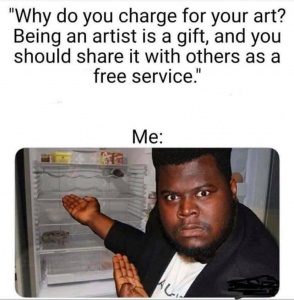
I recently had an artist friend post a meme:
My comment to the FB post? “Hey bub, being healthy is a gift. You should give your salary to charity.” (A couple members of her family are disabled, the types of invisible problems where everyone goes “just suck it up and get a real job,” since they are functional 2 to 3 hours a day. (o_O) You know, the time when they actually function well enough to go into public to shop or make doctor appointments.) She gave my response a heart-like.
Why does following your Passion have no Income reward?
Because it is a passion, people will accept any amount of money to do it. And the people who make money off of artists, dancers, singers, and writers know this.
If throwing an event, the venue and booze isn’t going to lower their prices. The only place to keep prices low is … (wait for it) the feature presentation – the draw for the actual event. So the event producers pay the artist gig level costs and pocket the rest.
Because, as a Duke Study shows, “workers’ passion is increasingly used as justification for their exploitation in today’s labor market.” (Voynovskaya 2019) Our culture embraces the myth of passionate work, telling us to find “our life’s calling at work”, and then turns around and says because we have job satisfaction, enumeration doesn’t have to pay as high. Bosses love passionate people who will work long hours and weekends, for little pay.
Why can’t we be passionate and make a living wage? Who is telling us to “Live Your Passion” and why?
Teachers are told to be passionate, cooks are told to be passionate. Heck, the cashier at the grocery store is told to be passionate about their job.
My take-away to all of this, I’m not quitting the day-job anytime soon.
But Mr. Wendig did have another point.
When should you seek your passion?
Now. Right Now.
Not tomorrow, not next year. Now. Work on it; study it.
You owe it to yourself. Don’t live your passion for others. Live it for you.
Image courtesy of Serge Bertasius Photography at FreeDigitalPhotos.net
Just don’t do it full-time.
Until you are ready. And it is okay to never be ready. You don’t need to eat Chocolate Cake every day to be passionate about it. Part-time and holidays is just fine.
I guess I will keep the day-job a little longer. But I still am going to Live My Passion.
I hope this blog helps you figure out how to live yours. Flip through the Bibliography below for more details.
Have you ever read a story out of order? Sometimes authors lead with the end of the story and the mystery is how the person ended up in that situation. “Dude, where’s my car?” and “The Hangover” are just two recent movie examples where people wake up after a night of debauchery wondering what happened to them and have to backtrack the night.
For writing, often a writer will drop readers in the middle of the action and in the second chapter backtracks a couple hours or days and fill in the backstory once the reader is hooked.
Today’s writing exercise is to create an out-of-order flash. Normally, this would be frowned on because the flash medium is too short for backstory and timeline confusion. But breaking the rules to learn a new skill is okay.
Often when setting up a story in this manner, the first action is set in present tense and the remembrance portion is written in past tense. When the action catches up to present, the verb tense returns to present tense.
Example starts: “I stopped digging when the hole was deep enough.” “Blood is not my color, but at least it was washing out.” “The hangover wasn’t bad until I moved my head into the sunlight. When I opened my eyes, I realized it wasn’t sunlight.”
Remember the mystery is how the person got from a “normal” state to their present craziness when writing timelines out of order. This focus keeps the reader on the hook until the end.
WRITING EXERCISE: Write out three things that will happen in a flash in time order, and then write the flash with #3 as the first piece of information presented.
***
My Attempt
Flash Title: Too Big I stopped digging the hole when it was deep enough. Mud covered me from head to toe which covered the blood. I hoped the mess would wash out, but burning everything remained an option. I had a stack of wood under a lean-to close to the house from clearing underbrush this summer which would provide a good firestarter. I didn’t want to run around starkers at home, but I’ve done that before chasing kids when I was younger and fitter and the young escape artists were slippery from their baths. Somehow the clothes would be taken care of before I went inside.
I wasn’t tracking evidence inside my home.
I guess I should start at the beginning.
Yesterday was normal. Wake up, take the kids to school, drop the spouse off at work, run errands, do the laundry at home – walking the dog between loads and picking up after the kids and setting up for dinner and paying bills and the hindered of other tasks needed to keep a house of six people alive. I work weekends while Samantha works weekdays, that way someone is always home with the kids. It does mean the two of us don’t spend time together much, but considering number five is on the way, we do spend enough time together for some things.
Then I got a call from school. Mardi had gone missing with two other children off the playground. I don’t remember getting to the school, but the time between me hanging up the phone and signing in at the office was four minutes. The school is five miles away.
She was still missing when I got there, police were arriving behind me. One of them may have been following me for speeding. Don’t know, don’t really care, but I didn’t get a ticket for it. The two other missing kids were eleven year-old girls, dark hair, dark skin, just like my Mardi. She takes after her mother but has my high cheekbones and narrow nose from my Native American ancestors. The two other girls were also mixed races.
The police didn’t like that pattern at all.
Well, long-story short, since this story should be about 500 words. The police have the bodies of the human traffickers. Well, the low-level guys.
Their boss is too big to fail.
The clothes burned fine once they caught fire, and Sam hosed me down once I got out of the backwoods. Not my woods, mind, the woods owned by the guy too big to fail. One of my buds who wasn’t able to help me today already is calling in an anonymous tip about a suspected body being ditched.
Too-Big-to-Fail is going to have a bad day tomorrow. Worse than mine was today.